
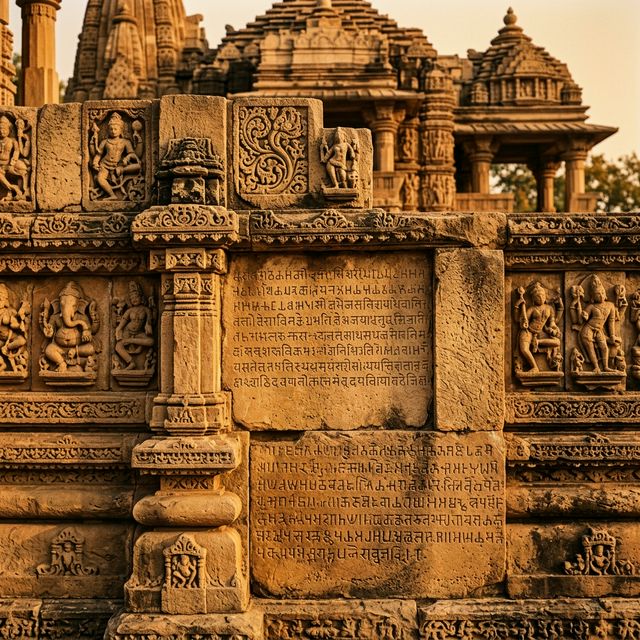
This stone inscription of Jayasimha, discovered at Tewar, Jabalpur, Madhya Pradesh, is a short epigraphic record currently preserved at American Oriental Society, New Haven. Incised in the Nāgarī script and composed in the Sanskrit language, the inscription refers itself to the reign of samrāṭ Jayasimhadeva and is precisely dated to the Kalacuri year 928, Śrāvaṇa śuddha 6, corresponding to 3rd July 1177 CE, Sunday representing an intercalary month.
The text begins with an invocation to Mahādeva, characterising him as the supreme Brahmaṇ and the repository of knowledge and bliss. It provides historical lineage, praising Narasimhadeva, the son of Gayākarṇa, before wishing long life and victory to his younger brother, the reigning monarch samrāṭ Jayasimhadeva. The administrative and religious core of the epigraph documents the construction of a temple dedicated to Īśvara by a local official, nāyaka Keśava. The builder is identified as the son of Āladeva and grandson of the brāhmaṇa Āstaka, belonging to the Kātyāyana gotra and residing at Sīkhā village in Mālavaka.
1. siddhiḥ | jñānānandam param braham brahmādisurasevitam | vandema-
2. hi mahādevam devadevam jagadgurum || 1 || śrīmadgayāka-
3. rṇṇanṛpasya sūnurnnareśvaraḥ śrīnarasimhadevaḥ | jigyedhari-
4. trīmanujosya samrāḍ jīyācciram śrījayasiṃhadevaḥ || 2 ||
5. viprasyāstakanāmno bhūdāladevastadātmajaḥ |
6. keśavaḥ kārayāmāsa prāsādamamumaiśvaram || 3 ||
7. samvat 928 śrāvaṇa sudi 6 ravau haste ||
8. nāyakakeśa vasyagotraṃ kātyāyanam sthānam māla-
9. vake sīkhāgrāmaḥ ||
Success
Verse 1
May we bow to Mahādeva, the god of gods, the father of the world, who is knowledge and bliss, the Supreme Brahmaṇ, served by Brahmā and other gods!
Verse 2
The illustrious lord of men, Narasimhadeva, the son of the illustrious king Gayākarṇa, conquered the earth. May his younger brother, the illustrious samrāṭ Jayasimhadeva, long be victorious!
Verse 3
The Brāhmaṇa named Āstaka had a son named Āladeva; his son Keśava caused this temple of Īśvara to be built.
Lines 7 to 9
In the year 928, on Sunday, the 6th lunar day of the bright fortnight of Śrāvaṇa, the moon being in the asterism Hasta. The nāyaka Keśava’s gotra is Kātyāyana, and his place of residence is the village Sīkhā in Mālavaka.
| Dynasty: | Kalacuri |
| Ruler: | Jayasimha |
| Date: | 3rd July 1177 CE, Sunday (Śrāvaṇa śuddha 6, varṣa 928) |
| Place: | American Oriental Society, New Haven |
| Donor: | Kēśava |
| Language: | Sanskrit |
| Script: | Nāgarī |
| Religion: | Śaivism |
| Deities: | Īśvara i.e., Śiva |
| Nature of grant: | Private donation, Religious endowment |
| Purpose: | To officially document the construction of a stone temple dedicated to Īśvara |
| Provenance of inscription: | Tewar, Jabalpur, Madhya Pradesh |
| Type of Inscription: | Stone Inscription |
| Source: |
Bibliography & Research
- Burgess, J., & Indraji, B. (1880). Chapter XVI: Three inscriptions from the cabinet of the American Oriental Society, New Haven, U. S. pp 105-112, here 110-111. In The Cave Temples of India. Archaeological Survey of India.
- Hall, F. E. (1860). Two Sanskrit Inscriptions Engraven on Stone: The Original Text with Translations and Comments. Journal Of The American Oriental Society, VI, 499-513, here 512-513.
- Kielhorn, F. (1894). III. Tewar Stone Inscription of the reign of Jayasimha. Epigraphia Indica, II, 17-19.
- Mirashi, V. V. (Ed.). (1955). Corpus Inscriptionum Indicarum Inscriptions of the Kalachuri Chedi Era. In (Vol. Vol 4 (Part 1), cvii-cviii and 344-346. Archaeological Survey of India.
