
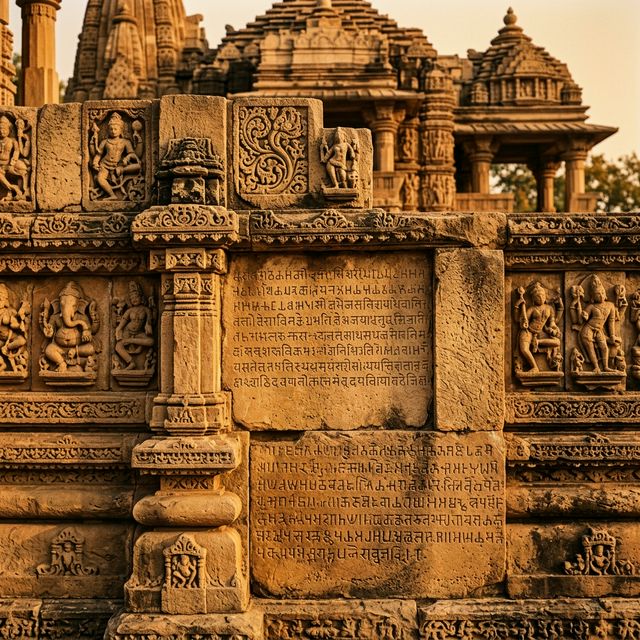
The Alhaghat stone inscription is a seven-line Nāgarī record written in Sanskrit, dated to Bhādrapada śuddha 1st tithi, Vikrama Samvat 1216 corresponding to 16th August 1159 CE, Sunday. The epigraph refers itself to the reign of the Kalacuri ruler Narasimhadeva, the mahārājādhirāja of Ḍāhāla
The text opens with an invocation of success and registers the victorious reign of Narasimhadeva. It records that rāṇaka Chhīhula, the son of mahārāṇaka Jālhaṇa of Pīpalāma fort, constructed the Shaṭashaḍikā ghat and built a temple for the goddess Ambikā near the road embankment to secure religious merit in the Kali age. This work is declared a means for attaining dharma, artha, kāma, and mokṣa. The deed is stated to have emancipated the entire Rautiā caste dwelling in Kauśāmbī. The epigraph concludes by naming ṭhakkura Kamalādhara as the writer, followed by the artisans Kamalasimha, Some, Kokāsa, Pālhaṇa, and Ḍalhaṇa who executed the project.
1. siddhiḥ | samvat 1216 bhādrasudi pratipadiravau || ḍāhālīyamahārājā-
2. dhirājaśrīnarasimhadeva vijayarājye || pipalāmadurggastha mahā-
3. rāṇakaśrījālhaṇaputra rāṇakaśrīcchīhulena kaliyuga-
4. dharmmārtham ṣaṭaṣaḍikāghāṭabandhanam mārggataṭāśmikā devī ca kari-
5. teti || dharmmārthakāmamokṣasādhanam || kausāmbīnikāyā rau-
6. ti-ā nāma jāti udharitaḥ || ṭhakura śrīkamalādharaṇa likhitam |
7. sūtradhāraḥ kamalasīmhaḥ | some | kokāsa || pālhaṇa | ḍalhaṇa ||
Lines 1 to 5
Success! In the year 1216, on Sunday, the first lunar day of the bright fortnight of Bhādra i.e., Bhādrapada, during the victorious reign of the illustrious Narasimhadeva, the Mahārājādhirāja of Ḍāhāla, the rāṇaka, the illustrious Chīhula, the son of the illustrious Jālhaṇa, the mahārāṇaka of Pipalāma fort, constructed the Ṣaṭashaḍikā ghat and the temple of the goddess Ambikā near the road leading to it for the acquisition of) religious merit in the Kali age. This is a means of acquiring religious merit, wealth, pleasure and liberation. The tribe of Rautiā (Rauts) living in Kauśāmbī has been liberated by this religious deed.
Lines 6 and 7
This has been written by the ṭhakkura, the illustrious Kamalādhara. The work was executed by the artisans, Kamalasimha, Some, Kokāsa, Pālhaṇa, and Ḍalhaṇa.
| Dynasty: | Kalacuri |
| Ruler: | Narasimha |
| Date: | 16th August 1159 CE, Sunday (Bhādrapada śuddha 1, Vikrama Samvat 1216) |
| Donor: | Rāṇaka Chhīhula |
| Donee: | The temple of Goddess Ambikā and the public |
| Language: | Sanskrit |
| Script: | Nāgarī |
| Religion: | Śaktism |
| Deities: | Ambikā |
| Nature of grant: | Public work, Religious endowment |
| Purpose: | To acquire religious merit in the Kali age, and to grant spiritual liberation to the Rautiā (Rāut) tribe of Kauśāmbī |
| Provenance of inscription: | Alhaghat, Rewa, Madhya Pradesh |
| Type of Inscription: | Stone Inscription |
| Source: |
Bibliography & Research
Cunnigham, A. (1924). Archaeological Survey of India Reports, Vol XXI, p. 115.
- Kielhorn, F. (1888). Four Rewa Copper-Plate Inscriptions. Indian Antiquary, XVII, 215-221, here p. 217.
- Kielhorn, F. (1889). Inscriptions of the King of Chedi. Indian Antiquary, XVIII, 209-219, here, 213-214.
- Mirashi, V. V. (Ed.). (1955). Corpus Inscriptionum Indicarum Inscriptions of the Kalachuri Chedi Era. In (Vol. Vol 4 (Part 1), cvi and 322-324. Archaeological Survey of India.
