
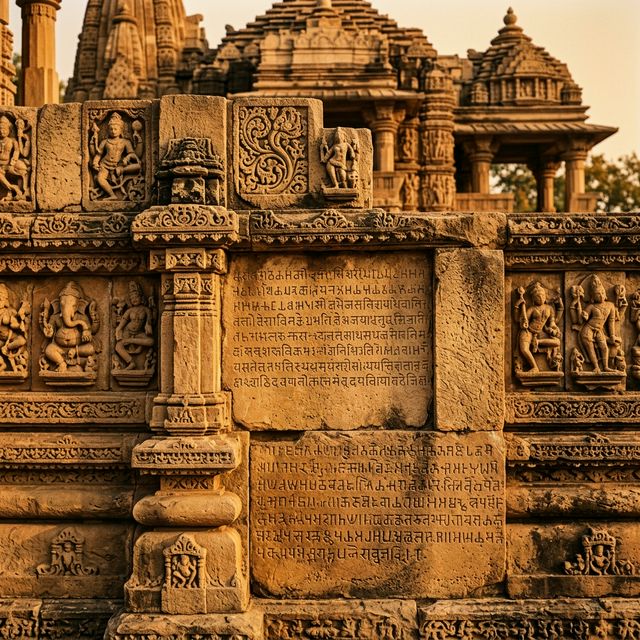
The Makundpur stone inscription of Gāṅgeyadeva, a three-line Sanskrit record incised on a stone slab near the Rupasagar tank in Makundpur, Rewa, was written in the Nagari script. First noticed by J. D. Beglar and analyzed by Franz Kielhorn, the inscription is dated to Wednesday, the twelfth lunar day of the bright fortnight of the month of Kārttika in the Kalachuri year 772 corresponds to 13th October 1019 CE.
The inscription records that during the reign of the Kalacuri ruler Gāṅgeyadeva, who holds the unconventional title mahārha-mahā-mahattaka, a merchant named śreṣṭhin Dāmodara constructed a religious edifice. Dāmodara, described as the ornament of the Grahapati family, commissioned this temple for Jalaśayana, an iconographic form of Viṣṇu reposing on water. The civic text concludes with a benediction wishing for bliss and good fortune, while explicitly attributing the mechanical execution of the architectural work to the artisan or Sūtradhāra named Sāmbhūka.
1. siddhiḥ | samvat 772 kārttika śu di 12 budhadine mahārhamahāmahattakaśrīmaharāja śrīgāṅgeyadeva rājye grahapati–
2. kulatilakaśreṣṭhidāmodareṇa jalaśayanamaṭham kāritam dharmoyam || maṅgalam mahāśrīḥ || siddhiḥ ||
3. sūttradhārasāmbhūkena ghaṭitamiti ||
Success! (In) the year 772 on Wednesday, the 12th (lunar) day of the bright (fortnight) of Kārttika, during the reign of the mahārha-mahā-mahattaka the illustrious mahārāja Gaṅgeyadeva, the merchant (śreṣṭhin) Dāmodara, an ornament of the family of Grahapati, has caused (this) temple of (Viṣṇu), who reposes on water, to be constructed. This is a pious work. May there be bliss and good fortune! Success! This work was executed by the Sūtradhāra artisan Sāmbhūka.
| Dynasty: | Kalacuri |
| Ruler: | Gāṅgeyadeva |
| Date: | 13th October 1019 CE (Kārttika śudi 12, varṣa 772) |
| Place: | Mukundpur, Rewa, Madhya Pradesh |
| Donor: | Śrēshṭhin (merchant) Dāmōdara |
| Donee: | The temple of Jalaśayana |
| Language: | Sanskrit |
| Script: | Nāgarī |
| Religion: | Vaiṣṇavism |
| Deities: | Jalaśayana i.e. Viṣṇu |
| Nature of grant: | Religious endownment |
| Purpose: | To record the construction of a temple (maṭha) dedicated to Jalaśayana (Vishṇu reposing on water) |
| Provenance of inscription: | Mukundpur, Rewa, Madhya Pradesh |
| Type of Inscription: | Stone Inscription |
| Source: |
