
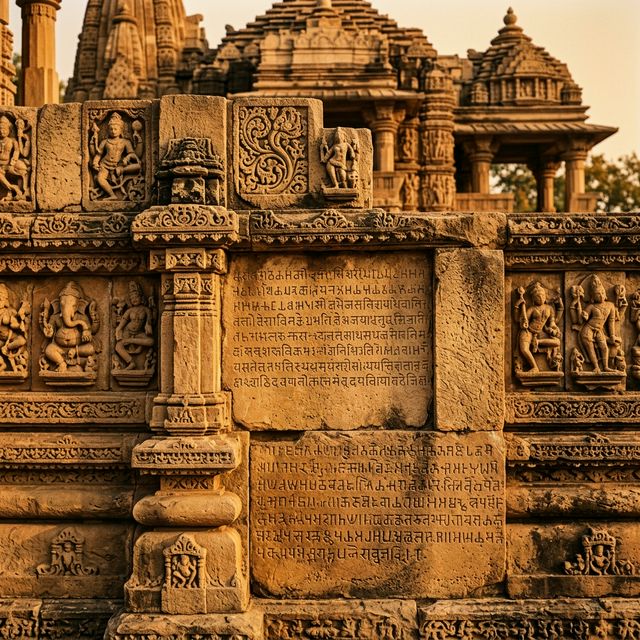
The Karitalai stone inscription of Lakṣmaṇarāja II discovered at Karitalai, Madhya Pradesh, now housed in the Central Museum, Nagpur. Written in the Sanskrit language using Nāgarī characters. The record belongs to the Kalacuri dynasty of Tripurī, mentioning three successive rulers: Yuvarājadeva I, Lakṣmaṇarāja II, and Śaṅkaragaṇa III, primarily focusing on the genealogical praise, administrative merits, and pious deeds of their ministerial lineage.
The text eulogizes Bhākamiśra, the minister of Yuvarājadeva I, and his son Someśvara, a learned scholar and minister under Lakṣmaṇarāja II whose palanquin the king himself once shouldered. Someśvara constructed a towering Viṣṇu temple, housing a boar incarnation named Somasvāmin. To support this establishment, Lakṣmaṇarāja II granted Dīrghaśākhika village to eight resident Brāhmaṇas and another estate during a solar eclipse. Queen Rāhaḍā donated Cakrahradī village, while the crown-prince Śaṅkaragaṇa III granted land during a lunar eclipse. Additional endowments included Callipāṭaka, Antarapāṭa, and Vaṭagartikā villages, fields, and diverse civic levies, including market tolls on grain, spirituous liquors, and betel leaves assigned to the deity.
 Editor's Comment:
1. nitarāndalena .. tāmraparṇṇītaṭaprāptai………………………… ..……………………………………………………bhū–
2. mestrīṇi padāni vāmanamahāpātrāya kṛttchrāddadau . pratyakṣīkṛtadāna eṣa tu janaiḥ prādādanabhyartthito grāmānbrāhmaṇajātaye bahutarāmstuṣṭāntarātmā………... 1 ..
3. vamśādbharadvājamuneranūnādguṇānato dharmma ivāparobhṛt . śrībhākamiśraḥ kṣitipapraṇamyaḥ śaśvatkṛtārtthīkṛtamārggaṇaughaḥ .. 2 .. kuṇṭitadhiṣaṇo dhiṣaṇo.asaumyaḥ
4. saumyo budho na budhaḥ . akaviḥ kavirapi yasmādatigrahopyevamagrahaścitram .. 3 .. yadanavadhivitānaprajvalajjātavedastatatarakharatāpottaptagātrī dharitrī . digibhabhujaga–
5. rājānantakūrmmaiḥ samūhe kalitadavathupīḍānaṣṭadhairyaiḥ kathañcit .. 4 .. yaśca .. acīkaratkutra na devaveśmānyacīkhanatkutra na vā sarāmsi . avivyadhatkutra na kūpavāpī–
6. rarūrupannāmravaṇāni kutra .. 5 .. avāpya yam śrīyuvarājadevo dharādharam prācyamivāmśumālī . prāponnatim vyastasamastadoṣām mantripradhānam kulagotracārum .. 6 .. na sandigdhe ve–
7. de dravadavadhiboddhā padavidheratarkyastarkeṣvapyanavamamatistantragatiṣu . ya ādyo vedānte smaraṇanipuṇaḥ kāvyasaraṇau sa tasyāsītsūnuḥ prathita iha sommeśvara iti .. 7 .. puste-
8. napāstamatirapratimaścaritre *yantrike kimapi yaḥ kuśalo babhūva . hastyaśvapālanaparīkṣaṇakarmmaśāstre ratnatrayepyanupamo dhuri dhīmatam ca .. 8 .. ekā kalā mūrdhni śaśā-
9. ṅkamaulerindoḥ kalāḥ pañcadaśa prasiddhāḥ . śrībhaṭṭasomeśvaradīkṣitasya kalyāḥ kalākīrttayitum kṛtī kaḥ .. 9 .. meruḥ sañcitakāñcanaikanicayaḥ puṣyattuṣārotkarairudbhūtoddhurajā-
10. ḍya eva himavānraudro giriḥ sphāṭikaḥ . arthiprattasamastahemanivahaḥ preddhaikabodhāvadhiḥ saumyosāvupamīyate kathamiva kṣmābhṛttrayeṇāmunā .. 10 .. apāstakuṅkumam ye–
11. na navanītamanīyata . vapuṣpraṇayitām yajñe vaśibhiduṣkaram hi kim .. 11 .. apāstakāñcirdhṛtamumjarajjurggaladdugūkūlo dhṛtadūravāsāḥ . alaukikatvena viśeṣacāruryadyo-
12. ṣitām parvvaṇi veṣa eṣaḥ .. 12 .. agnīdagnīnvihara vidhivaddugdhi homopayuktāmadhvaryyo gām srucamapi samam kṣālayāśu sruveṇa . taptairvvābhirbhavatusavidhe gārhapatyasya pa-
13. tnītye vam procurggṛhaśukagaṇā yajvano yasya sandhau .. 13 .. antarvvaśika vāsamandiramahī gandhodakaiḥ kṣālyatāṃ vārastrījana dehi bhāsvaraśikhāntratnapradīpānbahūn .. tvam sai-
14. rindhri nidhehi gandhamakhilam rājñi tvamapyādṛtā veṣe syā iti śārikoditamabhūtsāyam yadantaḥ pure .. 14 .. viśvepi viśvajitkoṭimagamansaptatantavaḥ . sarvvasvam dadatastasya śrīmaccedīndrama-
15. ntriṇaḥ .. 15 .. śaṣṭam yadyajñabhūmau raṇaśirasi sadā śamsitam hotṛsūtairggītam ṣaḍjādibhedairatimadhuragirodgātṛbhirggāthakaiśca . adhvaryyuḥ karmmavaryyaḥ pracarati ca karī dānasamsi-
16. ktahastastasya śrībhaṭṭasomeśvaraguṇagaṇane ke vayam tucchavācaḥ .. 16 .. vātandhamādhirohe bhraśyati dolābhṛti śramātkiñcit . śrīmallakṣmaṇarāja skandhamadādyasya dolāyām .. 17 ..
17. prāsādoyamakāritena kṛtinā devasya daityadruhaḥ śrīmaccedinarendramantritilakenācchāditāśāmukhaḥ . yasyorccaiḥ pavanāhato dhvajapaṭaḥ preṅkhanviyadgāminām samjñām vyā-
18. ghuṭane karotyaviratam ruddhādhvanotidhruvam .. 18 .. ṛjurati bahirantarādadhānaḥ kuṭilataratvamadhaḥ kṛtānyakīrttiḥ . piśuna iva samuddhato vibhāti prakaṭavilaṅghitasarvvaloka eṣaḥ .. 19 ..
19. lakṣmīndadhānopi purodadāno vimuktimādarśitaviśvarūpaḥ . kakṣāmagāhiṣyata dānavārereṣopyayāsyadyadi vāmanatvam .. 20 .. alamalamuruvamśaprāntasamsaktaśuklāṃśukaghaṭitaśa-
20. rīreṇocchritena dhvajena . kanakaka laśarocirddaṇḍalagnapravāhāmarasaridiha dhatte ketutāmeva nityam .. 21 .. unnatānām pariṣvaṅgo guṇāya mahate yataḥ . api durddarśano bhānurbhavatya-
21. tra sudarśanaḥ .. 22 .. dhvajapaṭavikaṭāntabhrāntisarpatsamīre miladamarasaritkevaśyamasyottamāṅge . taraṇirananubhūtam yāmayugmābhigamye nijarathaturagāṇām vātapṛṣṭhanda-
22. dāti .. 23 .. asyottuṅgottamāṅgānavaratagamanodghṛṣṭisīdadrathāṅgaḥ prātaḥ prātarddineśo ghaṭayati yugalam cakrayorvvītasaṅkhyam . śaṅke kūṭāntarālasthapuṭanipatanotthā-
23. ……………….daṇdaḥ . sāyam sāyam janānām kalayati nitarāmakṣavarggam samagram .. 24 .. nayati rathamamuñceddakṣiṇenonttareṇa syurati hi divasānām kuñcanaprāñcanāni . ta-
24. ……………………..meruyātepyabhijño dhruvamanabhivilandhyam prāpya sīdatyamandam .. 25 .. alaṅghyaśikharaśreṇilaṅghanavyasanādiva . pātaṅgiraṅghrivyāpattirasapātramabhū-
25. diha .. 26 .. ………………. varāhacaraṇakṣodādudañcatkiṇam pṛṣṭham me tava tatkṣaṇoddhṛtabisaprāyā śiraḥ santatiḥ . mā gādbhaṅgamitopasarppam nidadhe tattāvadetataddhruvam kūrmmasyāpi va-
26. ……………………….vāhe bhavan .. 27 .. kim bahunā .. sarvvaprāsādarājoyam niyatam pratibhātinaḥ . yadasya ketudaṇḍāgralagnaśchatrāyate vidhuḥ .. 28 .. stheyādākalpametatsu-
27. ………………..ramuṣya brahmāṇḍādhāramūrdhno dṛḍhatarajagatīniścalībhāvaśaṅkoḥ . kalpasyāvasthiti stānmuraripuśaraṇam yāvadetaccakāstītyetaccāśamsanam
28. …………………………krarūpam .. 29 .. nyavīviśatpure cāsminnaṣṭau bhaṭṭānvasūniva . dīrghaśākhikanāmānamebhyo grāmamadānnṛpaḥ .. 30 .. śrīmallakṣmaṇarājo grāmam devā-
29. ……………....................prādādasmai grahe bhānoḥ .. 31 .. nṛpānumatyā bhaktyā ca svīyayā tasya rāhaḍā . grāmam cakrahnadīmasmai mahādevī vyaśiśraṇat .. 32 .. śrīśaṅka-
30. ………………….smai . devāya dānaśauṇḍo grahaṇe somasya vaiṣṇava paramaḥ .. 33 .. dhavalaharāsambaddham prāyacchacchallipāṭakam grāmam . bhānorantarapāṭam grahaṇe devā-
31. ……………. .. 34 .. …………………………..lakṣetrakam dadau . tatsamīpe varāhāya kṣetram dvādaśakhaṇḍikam .. 35 .. mālādvādaśake grāmam śāsanam vaṭagarttikām . svakīyeśāsane śrīmānvalle-
32. …………….. 36 .. …………………………śāsane . śrīsomasvāmidevāya khārīvāpamihāgataḥ .. 37 .. purapattanayoḥ sthānaḥ śuklāmekādaśīm dadau . dvādaśīmapi yātrāyāḥ ṣo-
33. ……………... 38 .. ………………..kām tathā . nityamekām ghaṭīm goṇyām ṣoḍaśīdvitayam tathā .. 39 .. kaṣāyapañcake deśirddānamadhye nyavedayat . sārddhadvāvimśamamśam ca vāhyam pāda-
34. ……….. 40 .. ……………………………. vāgulikapradhānaśca parṇṇapañcāśatam dadau .. 41 .. parṇṇapañcāśadaparā dattā pāyaṭibhistathā . khalabhikṣāścatasraśca maṇḍalam sakalam dadau .. 42 ..
Verse 1
Bali unwillingly gave land measuring three footsteps to Vāmana, the great recipient of the gift; this Lakṣmaṇarāja on the other hand, whose charity is witnessed by the people, has always and with gratification given numerous villages to (members of) the Brāhmaṇa caste, though not entreated by them.
Verse 2
In the glorious lineage of the sage Bharadvāja was born, like a second Dharma, the illustrious Bhākamiśra who, modest by his virtues, was venerable to kings, and always rendered multitudes of supplicants happy.
Verse 3
On account of him, oh what a wonder! Bṛhaspati became confounded, the moon ugly, Buddha unwise, Uśanas ignorant, and the oppressive planet (Saturn) incapable of overtaking the people.
Verse 4
With his body oppressed by the very excessive and intense heat of the fires of his endless sacrifices, the earth was borne with great difficulty by the quarter-elephants, Śeṣa, the lord of serpents, and the Tortoise, who lost their patience on account of the pain they had to bear.
And he,
Verse 5
Where did he not cause temples to be constructed, tanks to be excavated, wells with steps and those without them to be dug, and gardens of mango trees to be planted?
Verse 6
Having obtained him eminent by noble descent, as his Prime Minister, the illustrious Yuvarājadeva (I) attained prosperity free from all deficiency, just as the sun being united with the eastern mountain which, being a principal mountain, appears beautiful, attains high altitude, completely dispelling the night.
Verse 7
His son was that Someśvara, well-known here, who felt no doubt in interpreting the Vedas; who was a complete master of grammar; who was an inconceivable adept even in logic; who had a superior intellect in the interpretation of Tantra (works); who was the foremost in Vedānta, (and) clever in remembering poetic compositions.
Verse 8
His intellect did not discard painting; he was incomparable in conduct and quite skilful in triple symphony; he was matchless in the sciences of the care and examination of elephants and horses and in the testing of the three kinds of jewels and was at the head of the intelligent.
Verse 9
There is only one kalā i.e., digit of the moon on the head of Śiva; the kalās of the moon are well-known to be fifteen in number; but who is able to enumerate the pleasing kalās arts of the illustrious Bhaṭṭa, the dikṣita Someśvara?
Verse 10
The mountain Meru is one mass of hoarded gold; the Himālaya has become extremely frigid by its increasing heaps of snow; the mountain of crystal i.e., Kailāsa appears dreadful. How can he (i.e., Someśvara), who has bestowed on supplicants his entire store of gold, who has reached the limit of highest knowledge, and who is gentle by nature, be compared to this triad of mountains?
Verse 11
In the sacrifice, he smeared his body with butter, discarding saffron; for, what is difficult to be accomplished by the self-controlled?
Verse 12
Of his wives this was the dress on the days of Parvan, especially charming, being uncommon, in which the girdle was set aside and a rope of muñja was worn instead, the silken garment dropped down from their bodies, and the linen cloth was chosen in its place.
Verse 13
The multitudes of the house-parrots of him, the sacrifice, said thus at each twilight: "Oh Agnidh! Kindle fires according to prescribed rules. Oh Adhvaryu! Milk the cow which is useful for the sacrifice, and wash the sruch together with the sruva quickly. Let the wife of the sacrificer attend the Gārhapatya fire with hot water."
Verse 14
In his harem, this was said by the sārikā every evening: "Oh Superintendent of the harem! Let the floor of the residential mansion be washed with scented water. Courtesans! Give me numerous jewelled lights with bright flames. Oh maidservant! Keep ready all the scents. Oh Queen! You also mind your dress!"
Verse 15
All the sacrifices of the illustrious minister of the lord of Chedi, who gave away in charity all his wealth, reached the standard of the Viśvajit sacrifice.
Verse 16
How insignificant are we of worthless speech in enumerating the merits of that illustrious Bhaṭṭa Someśvara, at the place of whose sacrifices and in the forefront of whose battles, hymns and eulogies are recited by the Hotri priests and bards, respectively; sāmans and panegyrics are sung in shadja and other notes and in an extremely sweet voice by the Udgātri priests and musicians respectively; and there moves about respectively the Adhvaryu priest, foremost in sacrificial work, whose hand is wet with the water poured in making gifts, and the elephant whose trunk is wet with rutting juice!
Verse 17
To his palanquin the illustrious Lakṣmaṇarāja (II) put his shoulder, when the bearer of it ascending to an airy place was stumbling a little on account of the fatigue of carrying it.
Verse 18
This temple of the god Viṣṇu the enemy of demons, which has covered the faces of all quarters, has been constructed by that virtuous and foremost minister of the illustrious lord of Chedi, (the temple) whose banner-cloth, which is incessantly fluttering, being struck by wind, is most assuredly making a sign to such as go through the sky to turn back from the temple which has blocked their path.
Verse 19
This high temple which appears very straight outside, but is very curved inside, which has surpassed in height the temples of others, and which has manifestly risen above the whole world, appears like an insolent calumniator who shows himself very straight forward outwardly, but is crooked at heart, who has disparaged others’ fame, and openly insulted all people.
Verse 20
This temple also, which, though possessing splendour, confers liberation, showing all forms by its sculptures in front would have borne resemblance to Viṣṇu the enemy of gods who, though he deprived Bali of his fortune, conferred liberation, showing him his all-embracing form, if only, like the latter, it had been small in size.
Verse 21
On account of the upraised flag of this temple made of a white piece of cloth attached to the (upper) end of an extremely high staff, the heavenly river, with its stream flowing along the staff which looks splendid with the golden jar on the spire of the temple, appears always to assume the very form of a banner.
Verse 22
Association with the exalted leads to great excellence; for even the dazzling sun can be easily looked at from here.
Verse 23
On the top of this temple which can be reached by the sun after a pair of watches i.e., six hours, where there is a cool breeze produced by the flapping of the large hem of the banner-cloth and where the heavenly river meets, the sun invariably gives a currying to his horses such as they had not enjoyed before at that time of the day.
Verse 24
Morning after morning the sun, the wheels of whose (chariot) break down, colliding against the high spire of this temple during his incessant roaming (through the sky), repairs both of them innumerable times. I fancy that every evening the banner-staff (of this temple) completely counts to the people all the axles (that had broken) owing to (the sun’s chariot) jolting in the cavity of the sky (caused) by the peak (of this temple).
Verse 25
If he, i.e., the sun’s charioteer were to take the chariot by the south or the north of this temple, there would be the untimely shortening and lengthening of the days; ......(So) expert as he is in crossing even the Meru mountain, he is not a little confounded when he reaches this temple which is firm and impossible to be crossed.
Verse 26
The son of the sun i.e., Saturn suffered (here) the pain caused by the injury to his legs as if because of his inordinate fondness for crossing the impassable row of the spires of this temple.
Verse 27
My back is becoming scarred, being trampled under the feet of the Boar! Let not the row of your hoods, which is (soft) almost like lotus-stalks just drawn out of water, break under my weight! Turn aside. Let me place this my body on the back of the Tortoise!......
What is the use of saying more?
Verse 28
This certainly appears to us to be the best of all temples, since the moon, when joined to the top of its flag staff, appears like an umbrella.
Verse 29
May this......of this temple, the top of which supports the egg of Brahman, and which is the peg that renders the earth immovable, last as long as the world! And may the world endure as long as this temple of Viṣṇu, the enemy of Mura, will shine......such is our wish!
Verse 30
The king made eight Brāhmaṇas, resembling as many Vasus, settle in this city (and) gave them a village named Dīrghaśākhika.
Verse 31
The illustrious Lakṣmaṇarāja (II) gave the village......to this god on the occasion of an eclipse of the sun.
Verse 32
His great Queen Rāhaḍā, with her devotion and the king’s consent, gave this god the village Cakrahradī.
Verse 33
The illustrious Śaṅkaragaṇa (III), the devout worshipper of Viṣṇu, skilled in charity, gave......on the occasion of an eclipse of the moon.
Verse 34
He gave the village Challipāṭaka, which is situated in the āhāra of Dhavala and Antarapāṭa on the occasion of an eclipse of the sun.
Verse 35
He gave the divine Boar the field......and also another yielding a crop of twelve khaṇḍis.
Verse 36
The illustrious Valleśvara gave as a grant, the village Vaṭagartikā situated in the Mālā group of twelve villages in his own territory.
Verse 37
He......who had come here, gave a field, sown with a khāri of grain, in his own territory, to the god, the holy Somaśvāmin.
Verse 38
The Superintendent of the city and the town gave to the god (the income?) on the eleventh day of the bright fortnight and also on the twelfth day during the fair of the god......
Verse 39
He......always gave a jar of corn for every goṇī, and also a couple of shoḍaśis i.e., karṣa.
Verse 40
The deśi offered one and a half times the one-twenty-second portion of the five spirituous liquors and a quarter of the goods carried into the town among these donations.
Verse 41
......And the chief of the Vāgūlikas gave a bundle of fifty leaves.
Verse 42
The Pāyaṭis gave another bundle of fifty leaves. And the whole maṇḍala gave the alms at four threshing floors.
| Dynasty: | Kalacuri |
| Ruler: | Lakṣmaṇarāja |
| Date: | c. 10th century CE |
| Place: | Central Museum, Nagpur |
| Donor: | King Lakshmaṇarāja II, Queen Rāhaḍā, Crown Prince Śaṅkaragaṇa III, Vassal Vallēśvara, the City Superintendent, the Trade Guild, the Chief of the Vāgūlikas, the Pāyaṭis, and the district head |
| Donee: | The deity Sōmasvāmin (Varāha) and eight selected Brāhmaṇas |
| Language: | Sanskrit |
| Script: | Nāgarī |
| Occasion: | Solar eclipse, a lunar eclipse, and scheduled religious temple fairs and festivals |
| Religion: | Vaiṣṇavism |
| Deities: | Avatar of Lord Viṣṇu: Varāha (the boar) |
| Nature of grant: | Religious endownment, Land donation and Revenue donation |
| Purpose: | To maintain of the Somasvāmin temple, worship of the Varāha (Boar) incarnation, and the settlement of eight brāhmaṇas |
| Provenance of inscription: | Karitali, Jabalpur, Madhya Pradesh |
| Type of Inscription: | Stone Inscription |
| Source: |
Bibliography & Research
- Cunningham, A. (1879). Report on a tour in the Central Provinces in 1873-74 and 1874-75 (Vol. IX). Archaeological Survey of India.
- Kielhorn, F. F. (1894). Karitalai Stone Inscription of Lakṣmaṇarāja II. Epigraphia Indica, II, 174-179.
- Mirashi, V. V. (Ed.). (1955). Corpus Inscriptionum Indicarum Inscriptions of the Kalachuri Chedi Era. In (Vol. Vol 4 (Part 1), lxvii-cviii and 186-195. Archaeological Survey of India.
