
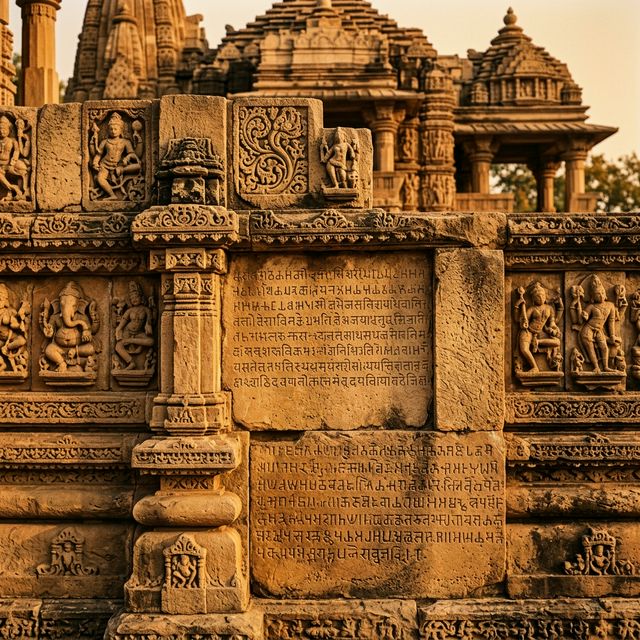
Discovered in 1928 at Karitalai, Jabalpur, Madhya Pradesh, this fragmentary Sanskrit inscription is associated with the Devī Māḍhiyā temple. Engraved in Proto-Nāgarī script, it is dated to Kalacuri Era 593, corresponding to c. 841–842 CE. The record was composed by Prasannāditya of the Ghaṭa family during the reign of King Lakṣmaṇarājadeva I of Tripurī. Owing to extensive damage, only the leftmost fifth of the original inscription survives, preserving portions of fourteen metrical lines.
The extant text opens with an invocation to Druhiṇa, Upendra, and Rudra, seeking their protection. Despite numerous lacunae, the surviving verses refer to the division of the four varṇas, the descent of the Gaṅgā from matted locks, and a ruler who acted as a thunderbolt against enemy kings likened to mountains. The preserved passages also allude to historical events, including the defeat of the Gurjara-Pratīhāra ruler Nāgabhata II and the religious devotion of the Rāṣṭrakūṭa king Amoghavarṣa I, who is described as bowing before a saintly preceptor devoted to the injunctions of Śruti and Smṛti. The inscription concludes with a reference to the construction of a temple resembling a mountain and attributes the composition of the praśasti to Prasannāditya during the sovereignty of Lakṣmaṇarājadeva.
1. siddhiḥ | om namostu druhiṇopendrarudrebhyaḥ || cāturvarṇṇyam ni…….
2. namāttram jagat | drāgeva druhiṇaḥ kṣiṇotu…………
3. ruddhavedhodṛśaḥ | pāyāsurmmadhusūdanācca……..
4. kaparddātpṛthuni pariluṭhantī yasya mūrddhasthale-
5. nakramaḥ paramiti svānputtrakānpāṭhayet………………
6. kṣīṇāmhaso jajñire yairāsantati santata-………………………
7. vṛttiḥ | balavibhavavilāsatyāgadākṣiṇya……………………..
8. mahābhūmibhṛdvajrapātaḥ samjahre hrī……….
9. bhūyasā cānehasā || bhagne nāgabhaṭe………………
10. kaṣagrāvadalako varāhavyāhāraḥ sma……………….
11. tismṛtyācārapravaṇadhiṣaṇaḥ puṇyacaritaḥ……………
12. yasya śrīmadamoghavarṣanṛpatiḥ pādau namasyatyayam
13. vāparaḥ || tenākāri nagānukāri ga…………….
14. siddhiḥ | samvat 593 śrīlakṣmaṇarājadeve rājani ghaṭānvayaśrīprasannādityasya kṛtiriyam |
Line 1
Success! Om! May there be adoration to Druhiṇa, Upendra and Rudra! The four castes......
Line 2
The world consists only of...... May Druhiṇa quickly destroy......!
Line 3
May (they) who obstructed the eyes of the creator......protect......
Line 4
On whose broad forehead (the Gaṅgā) rolling down from the matted hair......
Line 5
......would teach (his) little sons, (thinking) that the course (of teaching) is the best......
Line 6
(They), whose sins had diminished, were born; by whom......always down to their descendants.
Line 7
The course of conduct consists of strength, wealth, gaiety, liberality (and) courtesy......
Line 8
(He) who was a thunderbolt to the great mountains that were powerful kings, destroyed...... (while)......(was) resounding......
Line 9
...... after a long time. When Nāgabhaṭa (I) was routed.
Line 10
The roar of the Boar that rends rocks......
Line 11 and 12
......of holy deeds, whose mind was intent on (observing the rules of) conduct laid down in the śrutis (Vedas) and Smṛti......(and) whose feet [this] illustrious Amoghavarṣa salutes.
Line 13
......like a second......By him (has been) constructed (this temple) resembling a hill......
Line 14
Success! (In) the year 593, while the king, the illustrious Lakṣmaṇarājadeva (I) is reigning, this (praśasti) was composed by the illustrious Prasannāditya of the Ghaṭa family.
| Dynasty: | Kalacuri |
| Ruler: | Lakṣmaṇarāja |
| Date: | c. 841-842 CE (varṣa 593) |
| Language: | Sanskrit |
| Script: | Proto-Nāgarī |
| Nature of grant: | Religious endownment |
| Purpose: | To record the erection of a grand temple and to honor a highly revered spiritual preceptor |
| Provenance of inscription: | Karitalai, Jabalpur, Madhya Pradesh |
| Type of Inscription: | Stone Inscription |
| Source: |
Bibliography & Research
Hiralal, R. B. (1931). Choti Deori Stone Inscription of Śaṅkaragaṇa. Inscriptions in C. P. and Berar.
- Mirashi, V. V. (1935). No. 41. Karitalai Stone Insription of Lakshmanaraja: [Kalachuri Samvat 593]. Epigraphia Indica, Vol XXIII, pp. 255-260.
- Mirashi, V. V. (Ed.). (1955). Corpus Inscriptionum Indicarum Inscriptions of the Kalachuri Chedi Era. In (Vol. Vol 4 (Part 1), lxvii-cviii and 178-182. Archaeological Survey of India.
