
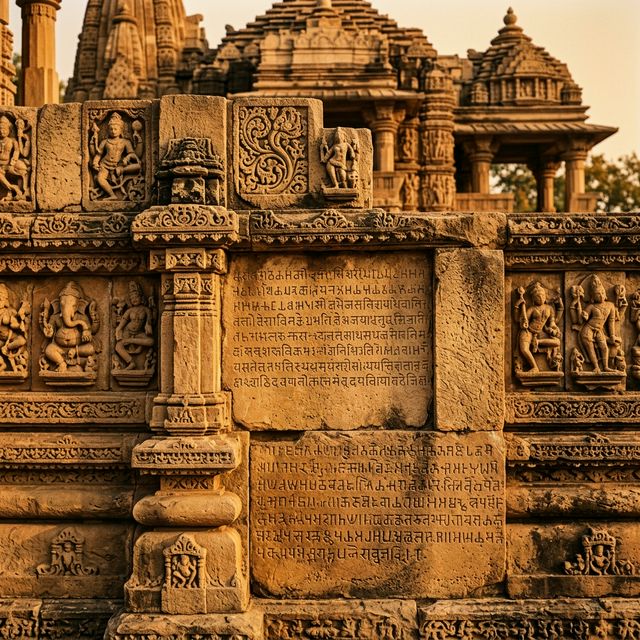
This stone inscription of Kokalladeva II, discovered among temple ruins at Gurgī (modern Gurh, Madhya Pradesh), is a forty-nine-line Sanskrit epigraph executed in Nāgarī characters. Composed in an ornate kāvya style, the record can be dated to the 10th century CE. Divided in three sections, it documents the Mattamayūra lineage of Śaiva ascetics, the history of the Kalacuris of Tripurī and the donations made by kings of this dynasty
Opening with invocations to Śiva as Somanātha, the text traces the Mattamayūra ascetic lineage through Cūḍāśiva, Prabhāvaśiva, Praśāntaśiva, Īśānaśambhu, and Prabodhaśiva, highlighting their construction of temples, monasteries, and retreats along the Son and Ganga rivers. The political section extols the Kalacuri rulers, detailing the military victories of Yuvarājadeva I and Kokalladeva II over the Gurjara, Gauḍa, and Kuntala sovereigns. It records extensive territorial endowments made by King Keyūravarṣa, specifying multiple villages, including Sārasaḍollaka and Karoḍhaka, alongside fields granted to the Somanātha temple for monastic maintenance. The record concludes by naming the composer Madu, the scribe Śivanāga, and the engraver Mādhava.
1. siddhiḥ namaḥ śrīsomanāthāya || laṅkādhīśeddhabāhuvyatikaracaṭulasphāṭikādrīndrakoṭiśreṇīsaṅghaṭṭabibhyad gaganacaravaracchannadikcakravālam |
2. ……… matyā jagadakṛta tadātrandanirhnādaghoram svacchandaḥ sodrivāsī mudamupacinutāccandracūḍāmaṇirvvaḥ || 1 || nandinkeyam praviṣṭā paśupati-
3. sadanam saiva devīti manye mithyaitannāsmi sānyā mama kathaya kapardasthitā kā taveśa | mugdhe tvadrūpadhārī tpridaśaripurasau dṛśyatām pātitogre kenāstreṇeti de-
4. vyā kaṭuvacanajitaḥ pātu maunī śivo vaḥ || 2 || saccaryācāryavaryā satata hutavahasnigdhadhūmaprabandhaprārabdhākālameghodayamadamuditonnā dinṛtyanmayūrā | a-
5. styuccaiḥ saudhajālajvaladanaṇumaṇijyotiṣāñcakravālaiḥ svarlokam vā hasantī jagati madhumatī dhāma saiddhāntikānām || 3 || pūrvve yatrāvatīrya vrataniyatamanovṛtta-
6. yastāpasendrāḥ śiṣyāṇāmāśaśamsuḥ śivamatamatanu vyastaniḥśeṣadoṣam | yeṣāmadyāpi kīrttirddhavalayati sudhādhautakāntiḥ prasiddhā viśvam sampannavidvajja-
7. nakumudavanānandinī candrikeva || 4 || śaivānāmanvayesminnatimahati munirmmānanīyo munīnāmena: śuṣkendhanānāndavadahana iva dyotamānairmmahobhiḥ |
8. śrīmāmścūḍāśivobhūdbhavacaraṇayugadhyānabodharddhilābha-prodbhūtātyantaśubhrattribhuvanabhavanābhyantara bhrāntakīrttiḥ || 5 || tasyākhilakṣitipatipraṇatottamāṅgacūḍā-
9. maṇidyuticayārccitapādapīṭhaḥ | śiṣyo babhūva bhuvanatrayakīrttanīyaḥ śrīmatprabhāvaśivanāmamunirmmanīṣī || 6 || ānīya yam sahajavāsanayā jayajñaḥ śrīmugdha-
10. tuṅgatanayo yuvarājadevaḥ | sattvopakārabhavaduttamakīrttihetoragrāhayanmaṭhamananta-dhanapratiṣṭham || 7 || tasyāmalena tapasā ca vivarddhamānavidyābalena ca sama-
11. stajagatpratītaḥ | śiṣyaḥ prakāmakamanīyaguṇaikadhāma śrīmatpraśāntaśivanāmamunirbbabhūva || 8 || ākṛṣṭā cirasañcitena tapasā yasyāṅgasaṅgotsukā lakṣmīrbhoga-
12. parāṅmukhasya satatam niḥśreyasākāmkṣayā | ājñām prāpya paropakārakṛtaye tadvallabhānām satām sthāneṣu sthiratāmavāpa vanitevātyantasatyavratā || 9 || tyāgam stambhami –
13. vāvalamvya vilasajjñānāmbusekakriyāmāsādya prasarattapobalakṛtapratyantarakṣākramaḥ | ittham yasya yaśo mayaḥ sa vavṛdhe kālena kalpadrumo yena vyāptamidam prasa-
14. hya sakalam brahmāṇḍabhāṇḍodaram || 10 || yena śrīyuvarājakāritalasatkailāsaśṛṅgopamaprāsādottarataḥ sumeruśikharasparddhi prasiddhambhuvi | sadma sthāpitamīśva-
15. rasya sakalatrailālokyavismāpakam yatsvarggam vrajatastadīyayaśasaḥ sopānamārggāyate || 11 || yaḥ pratyatiṣṭhipadumāmumayā ca miśra mīśam ṣaḍānanamatha prathitorukīrttiḥ |
16. prāsādasannihitadevagṛheṣu vidvāndvāre tathā gaṇapatiñca sarasvatīñca || 12 || dāgottirṇṇasuvarṇṇadānaśamitadravyārthisārthaspṛhaḥ siddhasthānamacīkarattadaparam yaḥ śo–
17. ṇatīropari | yasminyogajuṣaḥ praviśya niyamadhvastāntarāyādhayaḥ śāntāḥ siddhasamādhayo.acchamatayo gacchanti mukteḥ padam || 13 || tīrthasthānaniṣevaṇodyatadhiyā-
18. matyantaviśrāntaye yastatkāritavānmuniḥ surasarittīre tapaḥ sthānakam | yatsamsevya maheśvarārccanaratā vārāṇasīvāsino manyante bhavasāgaram gurumapi kṣīṇam
19. yathā goṣpadama || 14 || āsīnasya jitāsanasya vijane hṛtpadmamadhyasthitasthāṇudhyānanilīnaniścalamanaḥ sam-veditāntarmmudaḥ | jagmuryasya dināni dānanirata-
20. ……. pāñcārthika tattvajñānavicakṣaṇaiśca guṇibhiḥ sārddham parīkṣākṣamaiḥ || 15 || tīvrāmśoramśusaṅghā iva niratiśayollāsinaḥ svaiḥ prabhāvairyasyāntevāsinoghastamasi ni-
21. patitānpratyaham bodhayantaḥ | lokānālokadānopakṛtipariṇamatkīrttayaḥ sambhṛtājñāśobhā bhūbhṛcchirobhiḥ pravaramunijanaircya mānāścaranti || 16 || tasyābhava-
22. tparaśurāma iveśvarasya śiṣyaḥ samastakavirpugavagītakīrttiḥ | śrīśānaśambhurakhilāvanipālamaulimālāmaṇidyutipiśaṅgitapādapadmaḥ || 17 || nirjjitya
23. ……………… sarvvarthinām yena śrīrgamitopabhogapadavī daurggatyaduḥ khacchidā | sadvidyā bhavabandhanavyatikarapradhvamsa karmmakṣamavyāpāreti
24. samagrasa …………………………..|| 18 || yo mādyatkalikāladantidalanavyāpārapañcānanaḥ śrīmanmattamayūravamsa tilako niḥśeṣavidyānidhiḥ | vidvatpa-
25. rṣada…………………………….tasyāśeṣaguṇākarasya bhuvane kim nāma nālokyate || 19 || śrīmatprabodhaśivanāmanijānujasya sthānam samarpya viji-
26. tam nijabhaktiyogāt | śaivam jagāma bhuvanam || 20 || yena tyāgatapaḥ samādhinidhinā svasvāminirmmāpita-
27. …………………………………………….| ………………………………….. vāñchitasiddhibādhakabhiyā nollandhayantyambare || 21 || ku-
28. pam…………………………………………………….. |...........................arthinivahaprāptopyapūrvvepsitaprājyasva-
29. ………………………………… || 22 ||............................................... valla …………………………………..satkarmmanirmmāpitam |
30. ……………………………………………..|| 23 ||.............tadanu……………runnatātmā tasyāspade.agra-
31. ………………………|...................................... || 24 || ……………………………………..mahendrerbbude yasyoccaiśca
32. ………………………………………. | …………………………………………………………………..māsītkṣamaḥ || 25 || sāmantapāṭa-
33. ka……………yāyapu …………………………………..| ………………………………nīnām || 26 || eṇāṅkānvaya-
34. ………………………………………………………………….| ……………………………….gṛhītvābalātkhyātam kha-
35. ḍga ………………………….|| 27 || ………………………………………………| nirjjitya gūrjjarapatim
36. …………………………………………………|| 28 || ……………………………………………………………| ……parijanarakṣo-
37. ……………………………………|| 29 ||...................................................................................| sāmantamaulimaṇi-
38. rañjitapādareṇuḥ………….gajaghaṭā………………|| 30 ||.........................................................parākramobhūt | citrepi yakallita-
39. khitarūpamavekṣya ………….. vīravratam ……………|| 31 || ……….jā…………nijavairi……………….ṇa vikramanidhirviparītamallaḥ | āsīnnṛ-
40. paḥ kavikadambaghanāya māna…………………śaśāṅkaḥ || 32 || tasmādabhū …………… ditapuṣpadhanvasaṅgīryamāṇavapurapratimapratāpaḥ | kokalla-
41. devanṛpatiḥ patiruttamānām …………………..nāmśuḥ || 33 || praviśati hataśaktirgūrjjareśo hi mādrim jalanidhijaladurggam gauḍarājodhiśe–
42. te | nivasati vanavāse kuntaleśaḥ…………….maṇḍanam cāsya manye || 34 || sthānam ………….ya kīrttanīyam puṇyānvitāya munaye svayama-
43. rccitāya | ……….namullikhitaśā keyūravarṣanṛpatiḥ svayamājahāra || 35 || pakka …………..tam tathā sārasaḍollakam | vakkaḍollakarajyau-
44. ddhe ko ……..nāsapuṇḍikā || 36 || ………………….. puram khaṭollikā | nakalābhīrapallī ………….. sarasvatī || 37 || eteṣām dvādaśakañca kavacakṣetrameva ca |
45. sāmantapāṭakaścaiva vaṭa……………….|| 38 || ………….yātallapaṭī śāsanaṃ satramityapi | sa …………..bhaddhaci-urā kusumbā ca kukkūḍiyā || 39 || rajogrāmānvitā-
46. netānśā sanatvena dattavān | ………….siddhantapāragāya garīyase || 40 || puram paurajanākīrṇṇa …………..samastakam | bhaktyā samarppayāmāsa śāsanatve-
47. na bhūpatiḥ || 41 || karoḍhakam brahmapurīm susiddhārtha kapoṇḍikām | nanneśvarakṣetramadātsomanāthāya śambhave || 42 || dattā śrīyuvarājena pālitānantarairnnṛpaiḥ | ākalpa-
48. sthāyinī bhūyādvṛttiḥ śaivatapobhṛtām || 43 || bhāradvājānvayaśrīmattrayīvarddhananandanaḥ | praśastimakarotstutyo madhurmadhurayā girā || 44 || alekhi lekhakeneyama-
49. vvokatanujanmanā| akṣarairdṛṣati spaṣṭaiḥ śivanāgena dhīmatā || 45 || utkīrṇṇā sūtradhāreṇa maheśvarasutena ca | mādhvena na ……guṇinā viśvakarmmaṇā || 46 || siddhiḥ ||
Success! Adoration to the holy Somanātha!
Verse 1
May the self-willed moon-crested god Śiva living on the mountain Kailāsa, who made the world, which had its multitudes of quarters covered by the best of aerial beings terrified by the clash of the rows of peaks of the excellent crystal mountain Kailāsa, when it was shaken by the movements of the mighty arms of the lord of Laṅkā, dreadful with the echoes of their cries at the thought that it was the end of the world, increase your joy!
Verse 2
Nandin, who is this lady that has entered the abode of Paśupati? I think that she is none but your ladyship. This is false. I am not her. She is someone else. Oh Īśa! Who is seated in your matted hair? You are simple-minded, he is the enemy of gods who has assumed your form. See, I have thrown him down before me! By what missile? May Śiva, who was thus silenced, being vanquished by goddess Pārvatī with harsh words, protect you!
Verse 3
There is in this world Madhumatī, the abode of those who are versed in the Śaiva Siddhāntas, which contains excellent Ācāryas of noble conduct; in which the peacocks dance and shriek with joy at the untimely appearance of clouds caused by the uninterrupted mass of dark smoke of the ever-kindled sacrificial fires; and which laughs at the heavenly world with the mass of lustre of the large and resplendent jewels set on the rows of its high mansions;
Verse 4
Where appeared the first best ascetics whose minds were restrained by vows and who taught the great and flawless doctrine of Śiva to their disciples; whose well-known fame, having the bright lustre of nectar, even now whitens the universe, delighting the prosperous and learned men even as moonlight does the assemblage of night-lotuses.
Verse 5
In this very great succession of Śaivas there was the illustrious Cūḍāśiva, who was venerable to sages; who, with his shining lustre, was to sins what the forest fire is to dry fuel; (and) whose extremely white fame, which had arisen from the attainment of the perfection of knowledge through meditation on the feet of Śiva, roamed about inside the mansion of the three worlds.
Verse 6
His disciple was the wise sage called the illustrious Prabhāvaśiva, whose foot-stool was honoured by the mass of lustre of the crest-jewels on the heads of all kings bending in salutation, and who deserved glorification in the three worlds.
Verse 7
Having brought him out of a natural desire, Yuvarājadeva I, the son of the illustrious Mugdhatuṅga, who was versed in policy, made him accept a monastery, which was constructed at an enormous expense, with the object of gaining excellent fame arising out of the benefit to creatures.
Verse 8
His disciple was the sage, the illustrious Praśāntaśiva, the sole abode of the exceedingly attractive qualities, who became famous in the whole world by his faultless austerities and increasing learning.
Verse 9
Attracted by his long-accumulated austerities, the goddess of fortune, though eager for the bodily contact of him who was always averse to enjoyment on account of his desire to attain final emancipation, remained steadfast like an exceedingly virtuous wife in the houses of good persons who were dear to him, when she received his order to benefit others.
Verse 10
Having obtained the support of the post of (his) charity, having received the sprinkling of the water of (his) shining learning, and being protected all round by the force of (his) extending austerities, the wish-fulfilling tree of his fame grew up in course of time, which has completely filled the cavity of the vase-like universe.
Verse 11
To the north of the temple, resembling the shining peak of the Kailāsa mountain, which was caused to be built by the illustrious Yuvarājadeva (I), he erected a temple of Īśvara, well-known on the earth, which vies with the summit of the Sumeru mountain (in altitude), which causes wonder to all the three worlds, and which serves as a flight of steps to his fame rising to heaven.
Verse 12
The learned one, whose great fame was well-known, installed Umā, Śiva united with Umā, and the six-faced (Kārttikeya) in the shrines attached to the temple, and also Gaṇapati and Sarasvatī at the gate.
Verse 13
He, who had satisfied the desire for wealth of hosts of suppliants with gifts of gold which had emerged (purified) by burning, caused to be built another abode for the siddhas on the bank of the Śoṇa; having entered which, the tranquil Yogins, who have destroyed the impediments of mental anxieties by (the performance of) vows and who have clear minds, having attained success in meditation, reach the goal of final emancipation.
Verse 14
For the absolute rest of those who are intent on living in a holy place, he, the sage, caused to be built the well-known abode for performing austerities on the bank of the heavenly river Gaṅgā; having resorted to which, those who live in Vārāṇasī (Banaras), devoted to the worship of Maheśvara, consider the ocean of worldly existence, though extensive, to be as small in size as a puddle made by a cow’s foot.
Verse 15
Seated in a solitary place he who had mastered (all) the āsanas, who felt the inner joy with his steady mind absorbed in the meditation of Śiva seated in the midst of the lotus of the heart, and who was fond of making gifts, passed his days in the company of meritorious persons who were adept in the philosophy of the Pāñcārthika system and were capable of examining other systems.
Verse 16
Extremely resplendent by their own majesty like the multitudes of the rays of the sun, his disciples, who day by day arouse those who are steeped in ignorance as the rays awaken those enveloped by darkness; whose fame is due to the benefit they confer on the people by their gift of knowledge as that of the rays is due to the light they give; whose commands are borne by kings on their heads as the splendour of the rays is borne by mountains on their peaks, move about among people, being honoured by the best of sages.
Verse 17
His disciple was the illustrious Īśānaśambhu, even as Paraśurāma was of Śiva, he whose fame was sung by all great poets, and whose lotus-like feet were reddened by the rays of jewels on the rows of heads of all kings.
Verse 18
Having conquered ………………… he, who removed the misery of poverty, made the goddess of fortune become an object of enjoyment to all suppliants, and devoted himself to right knowledge, because it is capable of destroying the multitude of the bonds of worldly existence.
Verse 19
Of him, who was a lion in the act of destroying the rutting elephant that is the Kali age; who is the forehead mark of the illustrious Mattamayūra lineage, and the store of all learning……………; who is the source of all excellences in this world…………………………….. the assembly of learned persons……….what has not been observed.
Verse 20
Having made over his office as the head of the monastery to his younger brother, the illustrious Prabodhaśiva, he……………….attained the world of Śiva which he had won by his devotion.
Verse 21
By him who was the storehouse of charity, austerities, and meditation…………….was built a maṭha near the temple erected by his teacher………..which the celestial beings do not cross for fear of obstruction in the attainment of the desired siddhis.
Verse 22
And a well was dug by him………………….The host of suppliants also having obtained abundant wealth which they had not (even) longed for before………………………
Verse 23
…………………………….. caused to be built by his good work……………
Verse 24
thereafter, the high-souled one……………………….in his place………….
Verse 25
…………………….His fame………………………..on high on the Mahendra and Arbuda mountains……………………. was able………………
Verse 26
Sāmantapāṭaka…………………………..
Verse 27
In the lineage of the moon……………….having snatched the well-known sword by force…………………..
Verse 28
Having vanquished the lord of Gūrjaras……………………
Verse 29
………………………….. the protection of the family……………..
Verse 30
………………………… he, the dust of whose feet was reddened by the jewels on the heads of feudatories……………………………… the herds of elephants.
Verse 31
………………………………………… was born the valiant one………………… seeing whose beauty even as drawn in a picture…………………….. the vow of heroes.
Verse 32
……………………………….From him was born………………… the king who was the storehouse of valour, the terrible fighter………………… who was to the poets what a cloud is to the Kadamba trees…………………………..
Verse 33
From him was born the king Kokalladeva (II) of matchless prowess, whose beautiful form was praised by the god of love, who was the lord of the best……………….
Verse 34
The Gūrjara lord enters the Himālaya, being deprived of power; the king of Gauḍa lies in the watery fort of the sea; the lord of Kuntal lives in the forest………………………….. this I consider to be the ornament of his prowess.
Verse 35
The king Keyūravarṣa himself offered by an inscribed [charter] the famous abode…………………………. to the ascetic possessed of religious merit whom he himself worshipped……………………..
Verses 36 and 37
The villages Pakka-………………… and also Sārasaḍollaka, Vakkaḍollaka, and Rajyauddha…………………Nāsapuṇḍikā…………………..-pura, Khaṭollikā, -nakalā, Ābhīrapallī, ………………. and Sarasvatī.
Verses 38-40
The twelfth part of these and the Kavacakṣetra, and also Sāmantapāṭaka and Vaṭa-………………….Tallapaṭī, Bhaddhachiurā, Kusumbā, and Kukkuḍiyā, together with Rajogrāma, the king gave as a grant to the great ascetic who had completely mastered the Śaiva Siddhāntas.
Verse 41
The king gave through devotion the whole city crowded with citizens……………………as a grant.
Verse 42
He gave to the Śiva (called) Somanātha (the villages) Karoḍhaka, Brahmapurī, Susiddhārthaka, Poṇḍikā, (and) the Nanneśvarakṣetra.
Verse 43
May this provision for the maintenance of Śaiva ascetics, made by the illustrious Yuvarājadeva (I) and preserved by the succeeding rulers, endure till the end of the kalpa!
Verse 44
The praiseworthy Madu, the son of the illustrious Trayivardhana of the Bhāradvāja family, composed this praśasti in sweet words.
Verse 45
The intelligent scribe Śivanāga, the son of Avvoka, wrote it on the stone in clear letters.
Verse 46
It has been inscribed by the sūtradhāra, the skilled artist Mādhava, the son of Maheśvara……………………………..
Success!
| Dynasty: | Kalacuri |
| Ruler: | Kokalladeva II |
| Date: | c. 10th century CE |
| Place: | Royal Palace, Rewa, Madhya Pradesh |
| Donor: | Keyūravarṣa |
| Donee: | The god Śiva (Sōmanātha) and the Śaiva ascetics in charge of the temple |
| Language: | Sanskrit |
| Script: | Nāgarī |
| Religion: | Śaivaism |
| Nature of grant: | Eulogy, Religious endowment |
| Purpose: | To record the spiritual pedigree of Śaiva ascetics, the military exploits of the Kalacuri kings, and the specific royal grants made for the god Śiva and the support of the ascetics. |
| Provenance of inscription: | Gurh, Rewa, Madhya Pradesh |
| Type of Inscription: | Stone Inscription |
| Source: |
Bibliography & Research
- Banerji, R. D. (1921). Progress report of the A.S.I. (Western Circle Archaeology) 1920. Archaeological Survey of India.
- Banerji, R. D. (1931). Appendix C: New Inscriptions. In The Haihayas Of Tripuri And Their Monuments (117-142, here pp. 122-129). Archaeological Survey Of India.
- Banerji, R. D. (1933). No 17. The Gurgi Inscription of Prabodhshiva. Epigraphia Indica, XX, 127-135.
- Mirashi, V. V. (Ed.). (1955). Corpus Inscriptionum Indicarum Inscriptions of the Kalachuri Chedi Era. In (Vol. Vol 4 (Part 1), lxvii-cviii and 224-233. Archaeological Survey of India.

While verse 15 explicitly documents the adherence of the Mattamayūra ascetics to the Pāñcārthika philosophical system, noting their expertise in examining comparative sectarian doctrines; this epigraph also records the multi-centric geographic expansion of a monastic lineage, capturing the construction of a riverside temple on the river Sona and a secondary ascetic retreat at Varanasi on the river Ganga.