
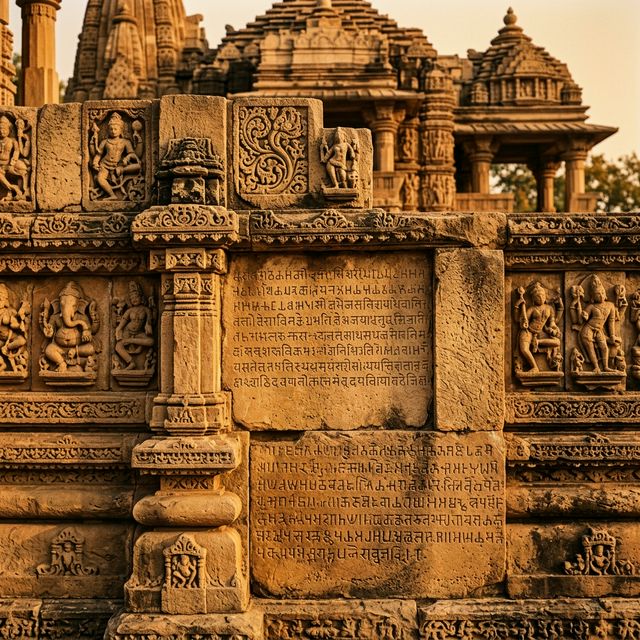
The Goharwa plates of Karṇadeva, consisting of two copper plates, bears a detached bell-shaped seal with aseated figure of the goddess Lakṣmī attended by elephants and a couchant bull. It has a legend, śrīmat Karṇadevaḥ, engraved around it. Written in the Sanskrit language, the inscription is engraved in Nāgarī characters.
The text opens with invocations to Brahman and Brāhmī and traces the dynastic descent from the Moon through a succession of legendary heroes to the historical rulers Lakṣmaṇarāja II, Yuvarājadeva II, Kokalla II, and Gāṅgeyadeva. It celebrates their victories over regions such as Baṅgāla, Aṅga, Kuntala, and Utkala. The charter records that Karṇa, bearing supreme imperial titles, issued the grant from his victorious camp at Karṇatīrtha. After bathing in the Gaṅgā at Arghatīrtha and worshipping Śiva, the king donated the village of Caṇḍapahā, situated within Kauśāmba paṭṭalā (modern Kausambi, Uttar Pradesh), to the brāhmaṇa Śāntiśarman of the Vidarbhi Kauṇḍinya gotra. The grant was executed on a Thursday, the full-moon day (pūrṇimā) of Kārttika, during the seventh regnal year of Karṇa which corresponds to 5th November 1047 CE.
First Plate
1. siddhiḥ | svasti || om brahāṇe namaḥ || nirguṇam vyāpakam nityam śivam paramakāraṇam | bhāvagrāhyam param jyotistasmai sadbrahmaṇe namaḥ || 1 || śuddhe hṛdayakṣetre vallīmiva ropayanti
2. yām munayaḥ | mokṣamahāphalajananī brāhmī sūkṣmāpi sā jayati || 2 || kṣīrodadheraparimeyasudhānidhānamāvirbabhūva bhavabhūṣaṇamindureṣaḥ |
3. asmādajāyata budhaḥ sa kila kṣitīśamādyam purūravasamāpa tanūjaratnam || 3 || iti mahati sudhāmayūkhavamśe nṛpatirajāyata mauktikāyamānaḥ |
4. alabhata bharatassa cakravarttītribhuvanabhūṣaṇabhūyamekameva || 4 || atroditoditakule jagatīpatīnāmīśaḥ kramādajani haihayacakravarttī | ya-
5. sya pracaṇḍabhujapañjaramadhyavarttī kārāgṛhe dhṛta iva prasabham daśāsyaḥ || 5 || vairidhvāntabhidaḥ sahasra karato bhūpālacūḍāmaṇeryasmādadbhutabāhuba-
6. ndhavidhuro naktañcara grāmaṇīḥ | helollāsitabāhudaṇḍavihitaśrīkaṇṭhaśailoddhatiḥ prāgvikrāntamamanyata svayamapi svapnendrajālopamam || 6 || yajñāgni-
7. dhūmaiḥ paritoṣitendrāstasmādbhūvanbahavo narendrāḥ | rājye na yeṣām virarāma vṛṣṭirvvipakṣanārīnayanāmbu vāhaiḥ || 7 || baṅgālabhaṅganipuṇaḥ pari-
8. bhūtapāṇḍyo lāṭeśaluṇḍanapaṭurjjitagurjjarendraḥ | kāśmīravīramukuṭārccitapādapīṭhasteṣu kramādajani lakṣmaṇarājadevaḥ || 8 || āsīdyadvi-
9. jayaprayāṇajanitavyāyāmaśvedodayātyūjjaitsainikagandhasimdhūra śiraḥ sindūrapūrāruṇaḥ tvaṅgattuṅgataraṅgatāḍitamahākṣoṇībhṛ-
10. dāmbhonidhiḥ pūrṇṇovairikaṭhorakaṇṭhadalanāsṛksindhupūrairiva || 9 || sāhityavidyālalanābhujaṅgo niḥśeṣadhātrīdharaṇāya śeṣaḥ | tataḥ sa
11. jajñe jagadeka-vamdyaścedīndracandro yuvarājadevaḥ || 10 || yauvanena tanau yasya pratāpenārimūrddhasu | kulādrikuñjeṣvaribhistribhistulyam padam |
12. dadhe || 11 || bhūbhārakṣamadṛkśruti praṇayinīmālam bamānastanum kurvvāṇaḥ samarepi nākapayagānāgacchato vidviṣaḥ | vikhyātām bhuvi bhūrimārga–
13. manāmuccairdadhadvāhinīm yaḥ sākṣātparameśvaraḥ samabhavatsamyakśivārādhanāt || 12 || dikparyantanikhāta yūpanicayaḥ kṣmāpālacūḍāmaṇesta-
14. smādadbhutavikramaḥ kramavaśātkokallanāmābhavat | cakre yadvijayaprayāṇapaṇavaḥ svarggāṅganāsaṅgamārambhe maṅgalatūryakāryamahitakṣoṇīpa-
15. tīnāṃ bhṛśam || 13 || āśājaye samadasindhuragandharoṣādyasyodyadāyatakarāḥ kakubhām karīndrāḥ | phūtkāramārttamiva khecaranāyakasya cakruḥ
16. kapolamadhupadhvanibhirnirāśāḥ || 14 || yasminsukhaikaprabhave prajānām tejonidhau cetasi varttamāne | tattve parasminniva yogamājām nitā-
17. ntamantastamasā pralīnām || 15 || ākrāmadūrddharvam brahmāṇḍasaṅghaṭṭasphuṭita yaśaḥ | manye yasyendunakṣatratārādyākāratām gatam || 16 || kārāpañjarabaddhakī-
18. ranṛpatirdīptoṅgalakṣmīcayaistasmātkuntalabhaṅgabhaṅgirasiko gāṅgeyadevobhavat | yenākāri karīndrakumbhadalanavyāpārasārātmanā
19. nirjityotkalamabdhisīmni vijayastambhaḥ svakīyo bhujaḥ || 17 || aguṇajñeti loleti khyātam yadiha duryaśaḥ | lakṣmyā tadadhunā ghautam divyamādāya-
20. tadvapuḥ || 18 || atimanorathamarthijane ghanaṃ diśati yatra sa kalpatarustaruḥ | ripuyaśaḥkumudākarabhāskaraḥ sutamasūta sa karṇṇanarādhi-
21. pam || 19 || ākrāntadṛptasāmantapratāpaprasarādiva | caraṇau raṇaśauṇḍasya soṣmāṇau yasya rejatuḥ || 20 || sphuradbhyām vajracakrābhyāmekavyājena ha-
22. stayoḥ | babhāra yaḥ śriyam sākṣādindropendravijṛmbhiṇīm || 21 || mūrddhoddhṛtadharābhāradikkuñjarakarāyatau | ānadyatām bhujau yasya heloddhata vasu-
23. ndharau || 22 || tyāvyasanino yasya vipulam śaṅkhayordvayam | nidhānam vidhinā manye dviguṇīkṛtamarpitam || 23 || uddaṇḍaśūṇḍāgraviniḥsṛite-
24. na phūtkāracūrṇṇīkṛtaśīkareṇa | muktātapatrāyitamambarārddhe yasya prayāṇe pṛtanāgajānām || 24 || nāham nātha vipakṣagotravasa-
Second Plate
25. tirnatyaktapūrvvasthitiryasyākhyātumitīva cedinṛpaterdikcrakramākrāmataḥ | prāntaśrāntavarūthinīkarikarāsphālā-
26. vahelollasatkallolāvalibāhudaṇḍamudadhiścakranda sāndrasvanaiḥ || 25 || yatkuntaprotaśatrusruta rudhirasurāpānamattapranṛtyadvetā-
27. lottāla tālāravabharitakakupcakraparyantasīmni | anyonyālakṣya vācām samiti sarabhasam dattahastādisamjñāvyāpāreṇāmarāṇām vararama-
28. ṇavidhiḥ kaṣṭamāsīnmuhūrttam || 26 || ānandamandasumanassumanovakīrṇasaṅgrāmaraṅgabhuvi bhūmibhṛtām purastāt | vīrasya vīracaritam nanṛte kaban-
29. dhairlakṣmīhaṭhagrahakaṭhorabhujasya yasya || 27 || nīteṣu pramadāviyogavidhinā prāgbrahmacārivratam sārddham bandhutayā gṛhasthapadavīm kārāgṛhasthāpanāt | vā-
30. naprasthapadam vanāśrayavaśādbhaikṣāccabhikṣoḥ sthitim | yenaivam caturāśramaikagurutā spaṣṭā kṛtā śatruṣu || 28 || yasyārthivrajavāñchitādhikaphala-
31. prāptyai niśamyātmabhūḥ prākpratyagdharaṇīdharāntaracarasphāradghoṣaṇāḥ | etan nirmitamāḥ purā parinmitam brahmāṇḍamasmin katham sammāsya–
32. nti yaśāmsi cedidinṛpaterityākulobhūcciram || 29 || kim tasya karṇṇanṛpatervvata varṇṇayāmo yasya dvijātijanaśāsanatāmyra paṭṭaiḥ | utkīryamāṇanibi–
33. ḍākṣaracakravālavacālitairbadhirabhāvāmiyāya viśvam || 30 || cha || sa eṣa paramabhaṭṭārakamahārājādhirājaparameśvaraśrīvāmadevapādānu-
34. dhyāta paramabhaṭṭārakamāhārājādhirājaparameśvaraparamamāheśvarapatitrikaliṅgādhipati śrīmatkarṇṇadeva nijabhujopārjitāśvapatigaja pa-
35. tinarapatirājatrayādhipatyaḥ śrīmatkarṇṇadevaḥ kuśalī || cha || jayaskandhāvāre śrīmattkarṇṇatīrthādhivāsite mahādevī mahārājaputro mahāma-
36. ntrī mahāsāndhivigrahiko mahāmātyo mahādharmmādhikaraṇiko mahāpratīhāro mahākṣapaṭaliko mahābhāṇḍāgāriko mahāsāmanto mahāpra-
37. mattavāro mahāśvasādhanikaḥ etānanyāścākīrttin yathāsthānaniyuktarājapuruṣānyathāsthāna kauśāmbīpattalāyām || candapahāgrāma-
38. nivāsino nikhilajanapadānyathāham mānayati bodhayati samājñāpayati | viditamastu bhavatām yathā grāmoyamasmābhiścaturāghāṭaviśuddhaḥ sajala-
39. sthalaḥ sāmramadhūkaḥ sagartoṣaraḥ salohalavaṇākaraḥ svasīmā paryantaḥ savanatṇayūtigocaraparyanto vidarbhīkauṇḍinyagotrāyāṅgirasāmba–
40. rīṣayauvanāsvatripravarāya vājasaneyaśākhine upādhyāyasīlūpautrāya āvasathikamālhūputrāya paṇḍitaśrīśāntiśarmmaṇe brāhmaṇāya
41. grāmoyaṃ eteṣām pevam kṛtvā śrīmatkarṇṇaprakāśe vyavaharaṇe saptama samvatsare kārttike māsi śuklapakṣakārttikīpaurṇṇamāsyām tithau gurudi-
42. ne evam samvatsaramāsapakṣatithivārānukrameṇādyeha śrīmadarghatīrthe gaṅgāyām snātvā bhagavantam śivabhaṭṭārakam samabhyarccya mātāpitrorā-
43. tmanaśca puṇyayaśobhivṛddhaye candrāvarkakṣitiparyantam śāsanatvena pradatta iti matvā yathādīyamānabhāgabhogahiraṇyādisamastarājapra-
44. tyādāyāḥ etasyājñāśravaṇavidheyībhūya dātavyāḥ | tadapacikīrṣayā madhye vātenāpi na gantavyami || cha || bhavanti cātra puṇyaślokāḥ |
45. sarvvānetānbhāvinaḥ pārthivendhrān bhūyo bhūyo yācate rāmabhadraḥ | sāmānyoyam dharmaseturnṛpāṇām kāle kāle pālanīyo bhavadbhiḥ || 31 || ba-
46. hubhir vasudhā bhuktā rājabhiḥ sagarādibhiḥ | yasya yasya yadā bhūmistasya tasya tadā phalam || 32 || bhūmim yaḥ pratigṛhṇāti yaśca bhūmim prayacchati |
47. ubhau tau puṇyakarmāṇau niyatam svargagāminau || 33 || ṣaṣṭim varṣasahasrāṇi svargge tiṣṭhati bhūmidaḥ | ācchettā cānumantā ca tānyeva narake va-
48. set || 34 || asminvamśe dvijaghnopi yaścānyo nṛpatirbhavet | tasyāpi karalagnoham śāsanam na vyatikramet || 35 || suvarṇṇamekam gāmekām bhūmerapye-
49. kamaṅgulam | harannarakamāpnoti yāvadābhūtasamplavam || 36 || likhitam cedam karaṇikaśśrīsarvvānandena | utkīrṇṇa ca vidyānandena || maṅgalam mahāśrīḥ ||
Line 1
Success! Hail! Om! Adoration to Brahman!
Verse 1
Adoration to that reality, Brahman, which is attributeless, all-pervasive, eternal and auspicious, the ultimate cause of the universe, (and) supreme light conceivable by the mind!
Verse 2
Glorious is that Brāhmī, which sages plant like a creeper in the pure field of their hearts, and which though subtle, bears the great fruit of final emancipation.
Verse 3
From the milk-ocean there came out this moon, the store of immeasurable nectar, which is an ornament of Śiva. From him was born Buddha. He, they say, obtained a jewel-like son, (namely) the primeval king Purūravas.
Verse 4
In that great family of the nectar-rayed (moon), there was born a king who appeared (bright) like a pearl. He, the universal sovereign Bharata, obtained (the distinction of) being the sole ornament of the three worlds.
Verse 5
In this very illustrious family of kings there was born, in course of time, the lord Haihaya, the universal sovereign; being caught in the midst of whose cage-like mighty arms, the ten-faced (Rāvaṇa) was, as it were, confined in a prison.
Verse 6
Finding himself (quite) helpless in the bondage of the marvellous arms of (that) crest-jewel of kings (i.e., Haihaya), who being thousand-armed routed his enemies even as the thousand-rayed (sun) dispels darkness, the leader of demons (i.e., Rāvaṇa), who had lifted up the mountain of Śrīkaṇṭha (Kailāsa) with his sportfully waved arms, himself thought that his previous valiant deed was like a dream and an illusion.
Verse 7
From him were descended many kings who pleased Indra with the smoke of their sacrificial fires; in whose kingdom there never ceased showers from the clouds which were the eyes of their enemies’ wives.
Verse 8
Among them was born in course of time Lakṣmaṇarājadeva (II) who was clever in routing the king of Baṅgāla; who defeated the Pāṇḍya (king); who was adept in plundering the king of Lāṭa; who vanquished the Gurjara king; and whose footstool was honoured by the crowns of the heroes of Kaśmīra.
Verse 9
The ocean, which became red, being flooded with (the streams of) vermilion from the heads of the huge scent-elephants in (his) army through exertion caused by his victorious marches, and which dashed against huge mountains with its dancing high waves, appeared to be filled as it were with the flooding streams of blood from the cut-off stiff necks of his enemies.
Verse 10
From him was born that Yuvarājadeva (II), the moon-like lord of Chedi, the sole object of veneration to the (whole) world, who was fond of literature as a lover is of his beloved, and who, like the serpent Śeṣa, supported the whole world.
Verse 11
Three things found a footing simultaneously, (namely) youth in his body, (his) valour on the heads of (his) enemies, and (his) enemies in the thickets on the principal mountains.
Verse 12
Through his devotion to Śiva he became actually an Emperor (or, Śiva incarnate), having acquired knowledge suitable for bearing the burden of (i.e., governing) the earth, being fond of the Vedas as Śiva is possessed of a body which is fond of serpents capable of bearing the burden of the earth; sending his adversaries along the path of heaven like Śiva; and leading his powerful army, famous in the world, which marched by several routes as Śiva bears on high the river Gaṅgā flowing in several streams.
Verse 13
From that crest-jewel of kings, there was (born) in course of time, (a king) named Kokalla (II), possessed of marvellous prowess, who planted a number of sacrificial posts in the farthest regions, and the drum, (beaten) at whose victorious march, served exceedingly well as an auspicious musical instrument at the commencement of the union of hostile kings with celestial damsels.
Verse 14
On the occasion of his conquest of the quarters, the lordly elephants (stationed) in the quarters, which raised their long trunks in rage on (smelling) the fragrance of his rutting elephants, despaired (of defeating them), (and) gave out, as it were, a distressing cry to the lord of celestial beings (i.e., Indra) through the hum of bees (hovering) over their temples.
Verse 15
While he, who was a store of valour and the sole source of (their) happiness, dwelt in the mind of (his) subjects, their inward distress completely disappeared even as the ignorance of the yogins does when the highest principle (Brahman), which is the repository of lustre and the unique source of bliss, shines in their minds.
Verse 16
His glory, rising high and breaking (to pieces) owing to its collision with (the upper shell of) Brahmā’s egg, has, I fancy, taken the forms of the moon, constellations, stars and so forth.
Verse 17
From him was (born) Gaṅgeyadeva, who threw into the cage of a prison the king of Kīra, who looked radiant with the mass of wealth of (the king of) Aṅga, who was fond of defeating (the king of) Kuntala in a (clever) manner, and who, strong as he was in the action of splitting open the temples of lordly elephants, made his (own) arm a pillar of victory on the shore of the (eastern) ocean, after vanquishing (the king of) Utkala.
Verse 18
By resorting to his divine person the goddess of fortune has now got rid of the infamy that she does not appreciate merit and is fickle.
Verse 19
Where he bestowed more wealth on suppliants than they desired, the wish-fulfilling tree was (no better than) an ordinary tree. He, who was to the enemies’ fame what the sun is to an assemblage of night-lotuses, begat the king Karṇa.
Verse 20
The feet of him (i.e., Karṇa) who was skilled in war, appeared lovely, being warm as if because they had trampled over the spreading valour of the neighbouring haughty princes.
Verse 21
Under the sole guise of (the symbols of) the thunderbolt and the discus on his hands, he bore (with himself) the goddess of fortune herself, who (usually) shines with Indra and Upendra.
Verse 22
His arms, which were long like the trunks of the elephants of the quarters, which have lifted up the earth with their heads, were delighted to rescue the earth with ease.
Verse 23
The two large (symbols of) conches on (his) hands were, I imagine, the treasure (of Kubera) which the Creator offered after doubling to him who was intently attached to charity.
Verse 24
At his march, the spray of water, which issued from the tips of the formidable trunks of the elephants in (his army) and which was turned to particles by their puffing, appeared like an umbrella in the sky.
Verse 25
I do not harbour, O Lord! the families of (your) enemies; nor have I transgressed the past limits. In order as it were, to say this to the King of Chedi, who was over-running the circuit of regions, the ocean roared in a deep sound, throwing about his arms of waves to scoff at the movements of the trunks of elephants in the army which, being fatigued, (had encamped) in its vicinity.
Verse 26
In his war, when the farthest confines of the circuit of regions were filled with the noise of the loud clapping of the goblins who were dancing in intoxication caused by drinking the liquor-like blood flowing from (the bodies of his) enemies wounded by his arrows, the ceremony of choosing (their) husbands in an assembly was, for a short time, performed with difficulty by the immortal (i.e., celestial) damsels, who could not hear one another’s words, by means of the hasty signs such as those of their hands.
Verse 27
On the stage of battle-field which was strewn with flowers scattered by the gods who were stupefied with joy, the heroic deeds of the valiant (Karṇa), whose arms were merciless in forcibly dragging the (enemy’s) fortune, were represented in dancing by headless trunks in the presence of kings.
Verse 28
He thus showed himself to be a unique teacher of the four āśramas to his enemies, who were first taught the vow of the Brahmacārin by being separated from (their) wives, (then) the order of the house-holder by being imprisoned together with their kinsmen, (then) that of the forest-dwelling hermit by (being forced to seek) shelter in the woods, and that of the religious mendicant by (being made to live on) alms.
Verse 29
Having heard the loud proclamations, resounding in the land extending from the eastern to the western mountain, that the hosts of suppliants (coming) to him would obtain gifts exceeding their desires, the self-existent (Brahmā) was long perplexed with the thought, ‘Alas! this brahmāṇḍa has already been created so limited in expanse! How will the glory of the King of Chedi be contained in it?’
Verse 30
What can we describe of that king Karṇa by whose copper-charters, (given) to Brāhmaṇas, which made a loud noise as multitudes of closely packed letters were being incised on them, the (whole) universe is deafened.
Lines 33 to 37
This paramabhaṭṭāraka, mahārājādhirāja, and parameśvara, the illustrious Karṇadeva, the devout worshipper of Maheśvara, the lord of Trikaliṅga; who has by his arm acquired sovereignty over the three kings, namely, the lord of horses, the lord of elephants, and the lord of men, (and) who meditates on the feet of the paramabhaṭṭāraka, mahārājādhirāja and parameśvara, the illustrious Vāmadeva, being in good health duly honours, informs and issues the (following) command at his victorious camp fixed at the famous Karṇatīrtha, to the following, namely, the mahādevī, the mahārājaputra, the mahāmantrin, the mahāsāndhivigrahika, the mahāmātya, the mahādharmādhikaraṇika, the mahāpratihāra, the mahākṣapaṭalika, the mahābhāṇḍāgārika, the mahāsāmanta, the mahāpramattavāra, the mahāśvasādhanika and other unnamed officers appointed to their respective posts as well as all people residing in their respective places in the village Candapahā in the pattalā of Kauśāmbī;
Lines 38 and 39
Be it known to you that for the increase of the religious merit and fame of our parents and ourself, we, having bathed at the glorious Arghatīrtha here and having worshipped the divine (god) Śiva today, Thursday, the full-moon day of Kārttika in the seventh year of administration rendered glorious by (us) the illustrious Karṇa; in the aforesaid year, month, fortnight, tithi and day respectively, have given as a grant, with the words ‘this village is his,’ this village, with its four boundaries well-determined, inclusive of water and land, the mango and madhūka trees, together with its pits and barren land, together with mines of iron and salt, extending to its boundaries and together with woods, meadows and pasture-lands, to last as long as the moon, the sun and the earth will endure; to the Brāhmaṇa the illustrious Paṇḍita Śāntiśarman, the son of Āvasathika Mālhū and grandson of the Upādhyāya Sīlū, of the Vājasaneya śākhā, the Vidarbhī-Kauṇḍinya gotra and the three pravaras Āṅgirasa, Ambarīṣa, and Yauvanāśva. Knowing this and submitting to him by listening to his commands, you should pay all royal dues such as bhāga, bhoga, gold and others to him as you paid them (to us in the past). None should trespass with a view to harm him. In this matter there occur the (following) holy verses:
(Here follow six benedictive and imprecatory verses.)
Line 49
This has been written by the Karaṇika, the illustrious Sarvānanda and engraved by Vidyānanda. (May there be) bliss and good fortune!
| Dynasty: | Kalacuri |
| Ruler: | Karṇa |
| Date: | 5th November 1047 CE, Thursday (Kārttika śuddha, varṣa 793; Regnal Year 7) |
| Donor: | Karṇadeva |
| Donee: | Brāhmaṇa Śāntiśarman |
| Language: | Sanskrit |
| Script: | Nāgarī |
| Occasion: | Kārttikī Pūrṇimā |
| Religion: | Vedic |
| Nature of grant: | Land donation |
| Purpose: | To record the permanent donation of the village Chandapahā to a Brāhmaṇa scholar |
| Provenance of inscription: | Goharwa, Banda, Uttar Pradesh |
| Type of Inscription: | Copperplate grant |
| Source: |
