
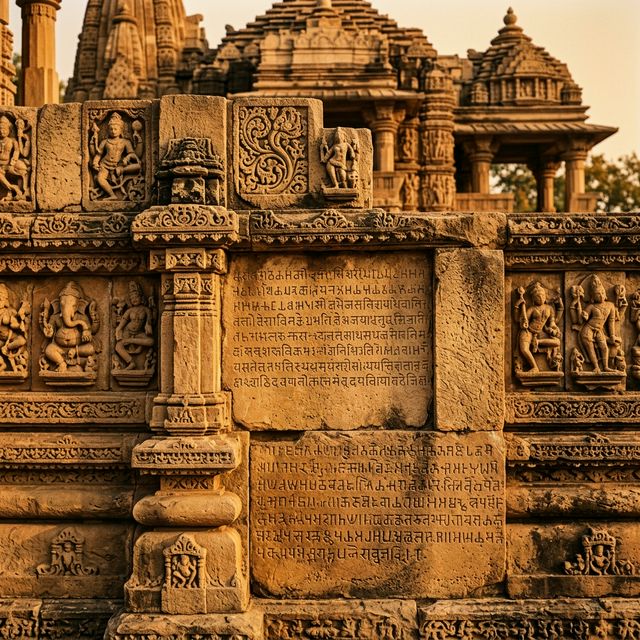
The Chandrehe stone inscription of Prabodhaśiva, incised on two sandstone slabs embedded into the monastery verandah at Chandrehe in Madhya Pradesh. The Sanskrit record, comprising twenty-seven lines, is engraved in the Nāgarī characters. The inscription is dated to the Phālguna śudi 5, Kalcuri year 724, corresponding to 10th February 973 CE.
Opening with invocations to Śiva and his tāṇḍava dance, the text records the spiritual lineage of the Mattamayūra clan of Śaiva ascetics, tracing the succession from Purandara to Śikhāśiva, Prabhāvaśiva, Praśāntaśiva, and finally Prabodhaśiva. It summarises the architectural and ascetic achievements of Prabodhaśiva, who practiced lifelong celibacy and undertook engineering works, including cutting roads through mountainous terrain and watercourses. He constructed the extant stone monastery adjacent to a temple built by his preceptor, excavated a large lake, and restored a dilapidated stone well. The praśasti concludes by naming the poet Dhāmsaṭa, the scribe Dāmodara, and the engraver Nīlakaṇṭha, operating under the direction of the master craftsman Sūrāka.
A
1. om namaḥ śivāya || phaṇiśvāsaśyāme svanadamaranadyambhasi ca yajjaṭājūṭāmbhode nayanaśikhividyudvilasati | tathā cūḍācandradyuti-
2. nikaradhāreva kakubham kapālānām mālā tulayati sa śarvvo vijayate || 1 || hamsaśyenī hasitamahasām samhatiśśaṅkarasya sphārībhūtā vadanamabhito
3. nāgacarmmāvṛtasya | kiñcitkaṇṭhacchavikaluṣitā meghaniryanmṛgāṅkacchāyām svacchām sapadi dadhatī sampadam vo dadātu || 2 || cārīsañcaraṇapravīṇacaraṇavyā-
4. pāraṇāghūrṇṇitakṣoṇīkuṇḍanamatphaṇīśvaraphaṇam vidrāṇadigvāraṇam | dorddaṇḍa bhramaṇādakāṇḍacalitabrahmāṇḍakhaṇḍam mude bhūyādvonibiḍa-
5. kvaṇaḍḍamarukam caṇḍīpatestāṇḍavam || 3 || śrīmanmattamayūrasantatiriyam gaṅgeva lokattrayam pūyādyatra purandaraḥ kṛtatapā jajñe gururbhūbhujām | śiṣyasta–
6. sya śikhāśivaḥ śikhisamo bibhrattapastejasā dīpatvam vinipātitāndhatamaso nirvvāṇamārggesthitaḥ || 4 || tato madhumatīpateḥ kṛtamahātapa-
7. ssañcayaḥ prabhāvaśiva ityabhūtsakalaśaivacūḍāmaṇiḥ | anekanṛpavanditaḥ sa yuvarājadevena yastapodhanapatiḥ kṛtaścaraṇapūtagolagnikaḥ || 5 ||
8. praśāntaśivacandramāstadanu tasya śiṣyobhavattamaḥ pramathanodyamaprakaṭitasvarūpaḥ śuciḥ | babhāra guṇiṣu śriyam kumudakalpaśaiveṣu yaḥ samujjvala-
9. yaśaḥ prabhāvabalitākhilāśāmukhaḥ || 6 || sa śoṇanadasaṅgame bhramaraśailamūletulam priyālavanasaṅkule phalamṛṇālakandāśanaḥ | cakā-
10. ra viditam janairmunisakhaḥ praśāntāśramam svapādapadapaṅktibhiḥ pavitabhūtalo yaḥ kṛtī || 7 || devodyānagatendrasamsadi mudā gandharvvavidyādharai-
11. rānandāya ca dhūrjjaṭeḥ ślathayatā vādyādaram nandinā | līlālolitamaulinā karagaladvalgena yasyoccakairbhāsvatsārathinā tathā
12. pratitapaḥ śaśvadyaśo gīyate || 8 || prabodhaśiva ityabhūtsakalaśiṣyavarggāgraṇīḥ sa tasya madanadviṣaḥ paraśurāmanāmā yathā | yaśaḥ khacita-
13. diṅmukho guṇijanāya vittam dadadṛṇīkṛtavasundharo vijitaśattruvarggaśca yaḥ || 9 || udagraśikhitarppaṇapraguṇitaikapāṇiḥ kṣaṇam kumāra
14. iva sarvvadā parihṛtāṅganāsaṅgamaḥ | samunnatamahībhṛti prakaṭitātmaśaktikramo manobhavaripupriyo vihitadevakāryaśca yaḥ || 10 ||
B
15. vicārya nikhilāgamānvidhisamādhibuddheśvaraḥ priyālaphalamūlakāmalakaśākaśālūkabhuk | nadokṣitadharātale gurujanānu–
16. kārī tapaścarañjagati vismayam vyadhita bālabhāvepi yaḥ || 11 || mahībhṛnmūrddhāgrapraguṇatarapādaḥ samudayī dadhanmittratvam yastimirabhidu-
17. ram kāryamakarot | tathā sandhyārambhe nikhilajanavandyaḥ kima param pratāpena vyāpnottribhuvanamapi prāptamahimā || 12 || gurugrāvagrāmotkhana–
18. nadalanadhvamsavidhinā mahīdhredhvānam yo vyadhita jaladhau rāghava iva | saritsrotaḥ svevam vipinagahaneṣvadbhutakaram jagatyāścaryam hi prathaya-
19. ti mahatkarmmam mahatām || 13 || jaḍataramarucchoṇasyāmbhaḥ kaṇairayamāśramo mṛgapatimahādhvānai rāttrau pratidhvanitāmbaraḥ | śikhariśikha-
20. raprāntapreṅkhaddvirephapayodharo janayati jane vidyucchaṅkām mahauṣadhirociṣā || 14 || cumbanti vānaragaṇā mṛgaśattrupotānsimhīstanam pibati cā-
21. trya śiśurmṛgasya | vairam nijam pariharanti virodhinonye sarvvasya śāmyati mano hi tapovaneṣu || 15 || gurukṛtasurāgārādārādamum ma-
22. ṭhamunnatam svakamiva yaśaḥ śubhrābhrābham viśālamacīkarat | anugiramatho sindhuprakhyam taḍāgamacīkhanatpracurasalilam kūpam cāttra
23. prabodhaśivaḥ śamī || 16 || śrīmatpraśāntaśivakāritamattra kūpam kālena śīrṇṇapatitākhiladārupūram | bhaktyā gurorguruśilāracanā–
24. vicittram socīkarattadanu dūramacīkhanacca || 17 || babhūva bhuvi dīkṣito vihitakīrttano mehukaḥ sa sajjanagaṇāgraṇīrajanayatsutam
25. je ikam | tatasttvamarikodare samabhavatkavirddhām saṭaḥ praśastimakarodasau vikaṭavarṇṇabandhāmimām || 18 || paśupatijaṭājūṭabhrāntā himā-
26. driśilātalaskhalitasalilā cañcadvīciḥ pavittritabhūtalā | vrajati saritām nātham yāvadbhagīrathavartmanā surasaridiyam tāvatkīrtiḥ sthirāstu bhuvi sthitā ||19|| la-
27. kṣmīdharasutaḥ khyāto vāsudevānujaḥ sudhīḥ | imām dāmodarolekhītpraśastim pravarākṣarām || 20 || sūtradhārasūrākājñayotkīrṇṇā nīlakaṇṭhena || samvat 724 phālguna śudi 5 |
Line 1
Om! Adoration to Śiva!
Verse 1
Glorious is that Śarva (Śiva), in whose coiled matted hair, which is like a cloud, being dark with the hissing of serpents on his body, and which resounds with the water of the heavenly river i.e., Gaṅgā as a cloud resounds with thunder, there flashes the fire of his third eye like lightning flashing in a cloud; and whose wreath of human skulls resembles a garland of campaka flowers, even as the shower of the accumulated lustre of the moon on his head!
Verse 2
May the mass of lustre of the laugh of Śaṅkara clad in an elephant-skin,—which, white like the goose, is spread round his face and which, being slightly darkened by the effulgence of his (blue) neck, at once assumes the clear splendour of the moon emerging from a cloud,—grant you prosperity!
Verse 3
May the tāṇḍava dance of Śiva, the husband of Caṇḍī, give you delight! The dance which makes the hoods of the lord of serpents bend under (the weight of) the bowl-like earth which revolves on account of the movements of his feet, skilled in the cārī step; which puts to flight the elephants of the quarters; which causes a sudden movement of a part of the universe by the revolutions of his staff-like arms, and which is accompanied by the deep sound of the ḍamaru!
Verse 4
May this continuous succession of the Śaiva ascetics of the Mattamayūra clan purify the three worlds, like the Gaṅgā in which was born Purandara, who performed austerities, and who was the spiritual preceptor of kings. His disciple was Śikhāśiva, who was like fire and who, refulgent with the lustre of his austerities, stood like a lamp on the path of final beatitude, having dispelled the pitchy darkness of ignorance.
Verse 5
From him i.e., Śikhāśiva, who was the lord of Madhumatī, was spiritually descended Prabhāvaśiva, who accumulated great austerities, was the crest-jewel of all Śaivas, and was revered by many kings. He who was the foremost among ascetics, was made by Yuvarājadeva (I) to sanctify, by his feet, the wanton woman that was the earth.
Verse 6
After him there was his disciple, the moon-like Praśāntaśiva, who was pure even as the moon is bright; whose real nature was manifested in his attempt to destroy ignorance as the moon’s form is seen dispelling darkness; who brightened the faces of all quarters by his bright fame as the moon does with her lustre, and who bestowed prosperity on the meritorious Śaivas as the moon bestows splendour on the fibrous night-lotuses.
Verse 7
He, the virtuous one, the companion of sages, who lived on fruits, lotus-stalks and roots, and who sanctified the surface of the earth by the rows of his footprints, built an incomparable and quiet hermitage, well-known to the people, at the foot of the Bhramara hill covered with the forest of priyāla (trees) (and situated) at the confluence of the river Śoṇa.
Verse 8
His fame is continuously sung with delight and in a high tone in every month of Māgha by the gandharvas and vidyādharas, in the assembly of Indra held in the celestial garden, by Nandin who, to please Śiva, pays less attention to instrumental music, and the charioteer of the sun, who gracefully waving his head from side to side in joy, allows the reins (of his horses) to slip from his hands.
Verse 9
There was the foremost of his disciples named Prabodhaśiva, as Paraśurāma was of Śiva the enemy of Madana, who, conquering all his enemies, adorned the faces of the quarters with his fame, and bestowing wealth on the meritorious, placed the earth under obligation.
Verse 10
He was like Kumāra i.e., Kārttikeya, whose one hand was skilled in making offerings at the proper time to the high flames of fire as Kumāra’s hand is in feeding his mighty peacock; who like Kumāra, always avoided the company of women; who showed the effect of his power on mighty kings as Kumāra exhibited that of his dart on the Krauñca mountain, who was devoted to Śiva, the enemy of the mind-born as Kumāra also was dear to him; and who performed all his duties towards the gods as Kumāra accomplished the work of the gods, viz., the destruction of the demon Tāraka.
Verse 11
He, having thought over all the scriptures, realised God by the performance of religious austerities and meditation, and living on the fruits of priyāla, āmalaka, greens and śālūka, caused the wonder of the world by practising austerities even in his boyhood on the bank (lit., the surface of the land) washed by the river Śoṇa, imitating his spiritual preceptor.
Verse 12
He, having attained power, has acted like the rising sun, whose feet are rendered more resplendent by the jewelled crests of kings who bowed to him, even as the sun’s rays are when they fall on the peaks of mountains; who has done the work of destroying ignorance as the sun dispels darkness; who is revered by all people at the time of making peace as the sun is at the beginning of twilights; and what more need be said, having attained greatness, has pervaded the three worlds by his power as the sun does by its heat.
Verse 13
He, by the process of excavating, breaking and ramming heaps of large stones, has constructed a wonderful way through mountains and across rivers and streams, and also through forests and thickets, as Rāghava (did) across the ocean. A great deed of the mighty proclaims wonder in the world!
Verse 14
At night this hermitage, that which is wafted with breezes, is extremely cool with the sprays of the water of the Śoṇa, which makes the sky reverberate with loud roars of lions, and which has bee-like clouds hovering round mountain peaks, causes people to suspect lightning on account of the phosphorescence of great medicinal plants growing near it.
Verse 15
In this place herds of monkeys kiss the cubs of lions, and the young one of a deer sucks at the breast of the lioness. Other hostile animals forget their natural antipathy to one another; for the minds of all become tranquil in penance-groves.
Verse 16
Near the temple built by his preceptor, the tranquil Prabodhaśiva caused this lofty and spacious monastery, which is, as it were, his own fame resembling white clouds. Thereafter he excavated a sea-like lake, by the side of the mountain, and also a well having copious water.
Verse 17
On account of devotion to his preceptor, he caused to be rebuilt with a wonderful masonry of large stones and then re-excavated very deep the well, which had been dug by the illustrious Praśāntaśiva at this place, but which had become dilapidated and full of wood fallen into it, in course of time.
Verse 18
There was a dīkṣita named Mehuka, whose fame was known on the earth. He, who was foremost among good men, begot a son named Jeevika. To him was born, from the womb of Amarikā, the poet Dhāmsaṭa. He composed this praśasti couched in a beautiful arrangement of letters.
Verse 19
May this eulogy endure unchanged on this earth as long as the divine river i.e., Gaṅgā, meandering through the coiled matted hair of Paśupati i.e., Śiva, with its waters shattering on the surface of the rocks on the Himālayas, flows to the sea, the lord of rivers, along the path shown by Bhagīratha, sanctifying the earth with its bounding waves.
Verse 20
The wise and renowned Dāmodara, the son of Lakṣmīdhara and the younger brother of Vāsudeva, wrote this praśasti in excellent letters!
Line 27
This praśasti has been inscribed by Nīlakaṇṭha by the order of the sūtradhāra Sūrāka. The year 724, the month Phālguna, the bright fortnight, the lunar day 5.
| Dynasty: | Kalacuri |
| Ruler: | Prabodhaśiva |
| Date: | 10th February 973 CE, Monday (Phālguna śudi 5, varṣa 724) |
| Place: | Chandrehe, Rewa, Madhya Pradesh |
| Donor: | Prabōdhaśiva |
| Donee: | Śaiva ascetics and the public |
| Language: | Sanskrit |
| Script: | Nāgarī |
| Occasion: | Completion of the construction of the monastery (maṭha) |
| Religion: | Śaivism |
| Nature of grant: | Eulogy, Religious endowment |
| Purpose: | To record the construction of a monastery (maṭha), the excavation of a lake and well, and the repair of an older dilapidated well |
| Provenance of inscription: | Chandrehe, Rewa, Madhya Pradesh |
| Type of Inscription: | Stone Inscription |
| Source: |
Bibliography & Research
Kielhorn, F. (1893). Candrehe Stone Inscription of Prabodhaśiva. Indian Antiquary, XX, p. 85.
- Banerji, R. D. (1931). Appendix C: New Inscriptions. In The Haihayas Of Tripuri And Their Monuments (117-142, here pp. 117-122). Archaeological Survey Of India.
- Banerji, R. D. (931). No 23. The Candrehe Stone Inscription of Prabodhaśiva. Epigraphia Indica, XXI, pp. 148-153.
- Mirashi, V. V. (Ed.). (1955). Corpus Inscriptionum Indicarum Inscriptions of the Kalachuri Chedi Era. In (Vol. Vol 4 (Part 1), lxvii-cviii and 198-204. Archaeological Survey of India.

While verse 17 provides indicates Prabodhaśiva cleared an older masonry well built by his preceptor Praśāntaśiva, which had accumulated structural wood and organic debris over time, subsequently deepening the shaft and reinforcing the subterranean chamber with heavy stone block masonry direct architectural documentation of early medieval monument restoration, this inscription provides an uninterrupted spiritual succession (guru-śiṣya-paramparā) of the Mattamayūra lineage of ascetic preceptors.