
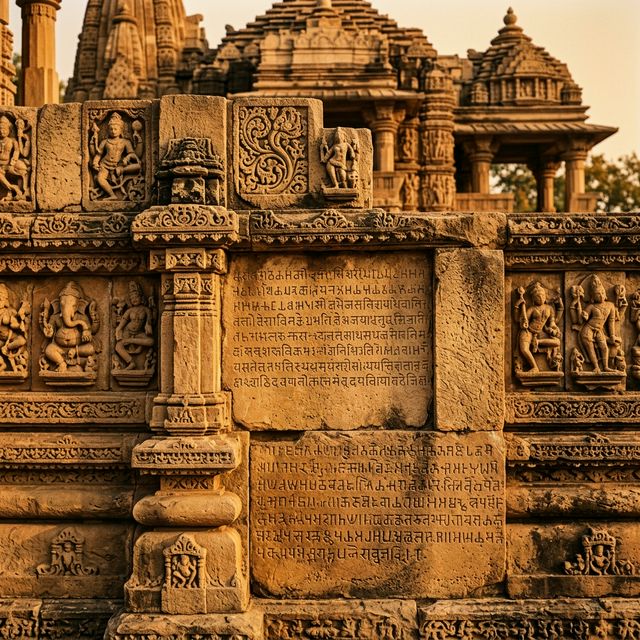
The Bilhari stone inscription of the Kalacuri ruler Yuvarājadeva II, discovered in Madhya Pradesh and preserved in the Central Museum, Nagpur, is a Sanskrit epigraph incised in Nāgarī characters. Written in an ornate kāvya style, this text represents a collaborative literary effort composed by three distinct authors: Śrīnivāsa, Sajjana, and the Kāyastha Sīruka.
The eulogy opens with invocations to Śiva before tracing the Haihaya lineage through Kokalladeva I and Mugdhatuṅga to Yuvarājadeva I, whose Caulukya queen, Nohalā, erected a Śiva temple and endowed villages to the Śaiva ascetic Īśvaraśiva. It delineates the spiritual lineage of the Mattamayūra clan at Kadambaguhā, noting that Lakṣmaṇarāja II entrusted the Nauhaleśvara monastery to Hṛdayaśiva and presented a golden Kāliya effigy, seized from Oḍra, to the Somanātha temple. Following mentions of Śaṅkaragaṇa III and Yuvarājadeva II, the epigraph details specific marketplace tolls and cash levies in Bilhari to maintain the monastic establishment under Aghoraśiva, concluding with an endorsement associated with the poet Rājaśekhara.
1. siddhiḥ | om namaḥ śivāya || pāyādvaḥ sa samastamaṅgalanidhiḥ śambhorjjaṭājūṭako yasmillelalasaddyumaṇḍalagalanandākinīvāribhiḥ | gāḍhagranthinipīḍitoragapati prasphāraphullatphaṇābhīmavyāvṛtavaktramārutadhṛtaiḥ śvetātapattrāyitam || 1 || api ca || avyādvaścandracūḍasya locanārcciṣmataḥ śikhā | mitrameṣa smarasyeti dagdhum vidhumivodgatā || 2 || yam khelāya ṣaḍānanaḥ śiśutayā kṛtvāgraham mārgati grantho yaśca
2. durodaraiḥ purabhido devyā samam dīvyataḥ || kelīkopakathāsu yena tanute hetikriyām pārvvatī pāyādvaḥ sa jaṭāvanaikakusumam śārvvaḥ sudhādīdhitiḥ || 3 || dikṣu premkhābhiyogapravalitabalanāvibhramāakāṇḍa caṇḍairdodaṇḍānām prakāmaprathimabhiranilairdūramutsāritāsu | kim ca prasphāracārīnamadavanivaśādvyomni yāte mattāmavyādavyāhateccham tripuravijayinastāṇḍavāḍambaram-
3. vaḥ || 4 || vamśetra somasambhūtau vācam nikṣipatā mayā | hanta hastairupakrāntā mohena viyato mitiḥ || 5 || vācāmujjvalimāpi nāsti yadi me tatkīrttyamānonnaterasmādeva mahīyasaḥ śaśabhṛto vamśātsa sampatsyate | yadvā paśya nisarggakālimabhuvopyāśebhadānacchaṭāḥ kṣīrodanvati kinna saṅgatibhṛtastacchāyatāmbi bhrati || 6 || nettrādattrerddharittrīdhavalanasuhṛdām dhāma dhāmnāmudañcallokālokam yadā-
4. pa prabhavamatalinadhvāntavidhvamsahetuḥ | soyam somābhidhānatistalakayati kalā maulimasyaiva śambhorasmādeva pravṛttaḥ kimaparamayamapyanvayo haihayānām || 7 || asmimśca vandyatamatāṅgamite budhādyairādyairnṛpairnṛpatirarjjuna ityudāraḥ | āsīddvi ṣadvipinakarttanakīrttanīyakīrtticchaṭācchuritadīrghadigantarālaḥ || 8 || yadvakṣastaṭatāḍanātitaralatruṭyatpaviprocchalajjvālāmālika–
5. rālitena kariṇā devādhipaḥ kvāpyagāt | līlollālitaśarvva parvvatapatestasyāpi laṅkāpateryadvai ravyavasāyino yadabhavatkhyātipramāṇam hi tat || 9 || dattāttreya iti prakāmakalālīlāyitānāmpadam yo devaḥ sa sutapratiśrutavacaḥ prītyā yamanvagrahīt | ke vā tadguṇavarṇṇane vayamaho kim phalgubhirjalpitairmmanye sāpi ca vāgvapurbhagavatī tattra sphuṭam muhyati || 10 || atha tatastatasatpuruṣavratavratatiparvvatataḥ kati nā-
6. bhavan | taruṇatārakarājaparājayavyasanikīrttibhuvaḥ patayo bhuvaḥ || 11 || teṣvevam sambhavatsukramamanu manujāścaryatāmādadhāno dhanyānāmekasīmā samupanatamahīmaṇḍalākhaṇḍalābhaḥ | jātaḥ kokalladevo daladahitalatādāhadāvāyamāno mānottamsasya yasya ttribhuvanavalayavyāpanobhūtpratāpaḥ || 12 || bhuvanavijayahetormmuktamaryādayādassadaranalaḍitalolairyadbalaissamvaladbhiḥ | atalinatarabhārabhraśyadurvvī-
7. viṣīdatphaṇaphalakakalāpo bhogibharttābabhūva || 13 || śyāmāśaṅkibhirākulairvvijaghaṭe cakrāhvayānāndvayairambhodāgamavibhrameṇa vidadhe lāsyotsavaḥ kekibhiḥ | bhagnālokamakāṇḍa eva ca dṛśāmāndhyena lebhe padam yatsenārajasi kramādavanitastārāpathe lupyati || 14 || velāvanapraṇayisai nyabhare ca yattra majjadbhirākulakulādrinibhairibhendraiḥ | sambhrāntamandaragiressamayasya tasya kālādbahoḥ smaraṇamāpa nidhirjjalānām || 15 || yata-
8. śca vaindhyantaṭamādadāne dāneddhasenāgajabhañjanena | amañjuśiñjānaśakuntacakrañcakranda duḥkhādiva vṛkṣajālam || 16 || jitvā kṛtsnām yena pṛthvīmapūrvvaṅkīrttistambhadvandvamāropyate sma | kaumbhodbhavyāndiśyasau kṛṣṇarājaḥ kauberyāñca śrīnidhirbhojadevaḥ || 17 || babhūva tasmādatha mugdhatuṅgastuṅgastrilokyāmaparo na yasmāt | diśaśca yaḥ kiñca vijetukāmaḥ kāmastuśattrunam bhuvam vilebhe || 18 || śayyā saṅgrāmalakṣmyāḥ parabalaparighaḥ pallavaḥ kopavallyāḥ preyo darppasya mittram sucaritasali-
9. lasyendranīlapraṇālaḥ | śākhā sauryadrumasya prasaraṇasaraṇiśśāśvatī sāhasānāmāsīdyasyāsireva pradhanaparikarārambhiṇaḥ prītapāttram || 19 || valgadvetālavarggam ttruṭitanijaśirodhāridhāvatkabandhaṇḍātkurvvaḍḍākiḍimbam mukhabilavilasatsammukholkāmukholkam | māmsagrāsābhilāṣasvanadaśivaśivābhairavārāvaraudram raudram yo dhāma bibhratpratisamaramiti dveṣicakrañcakāra || 20 || upavipinabhuvo nidherjjalānāmadhivasatā kaṭakena yasya yātuḥ | ava-
10. cayavicaladvadhūkarāgradviguṇitavidrumapallababhūvuḥ || 21 || iha vihitavilāsā vīcayo vārirāśeriha sa vahati vāyuḥ keralīkelikāraḥ | iha harati bhujaṅgassaurabham bhūruhāṇāmiti malayasamīpe yadvicārāḥ praceruḥ || 22 || vijitya pūrvvāmbudhikūlapālīḥ pālīssamādāya ca kosalendrāt | nirantarodvāsitavairidhāmā dhāmādhikaḥ khaḍgapatiryam āsit || 23 || gauḍīgāḍhamanomanorathakaraḥ karṇṇāṭakāntākucakrīḍāśailataṭīvihārahariṇo lāṭīlalāṭāṅkadaḥ | kāśmī-
11. rīvihitasmaravyatikarastasmātkaliṅgāṅganāsadgānavyasanī sa nītinayanaḥ keyūravarṣobhavat || 24 || āśāpālaparājayāya janitattrailokyaśaṅkāpadaṃ sainyairyasya yugāntakelikalanairddattaprayāṇairapi | na prodbhatimavāpa pāṃśupaṭalaṃ bhūyo gṛhītadviṣadvandīvṛndavahadvilocanapayaḥ pūraplutāyāṃ bhuvi || 25 || yassaṃyati prakaṭapāṭitakumbhikumbhamuktāphalapracayabāhamuvāha devaḥ | bhūyo nipītadṛḍhapīḍanavegavāntavidveṣikīrttikaṇakīrṇṇamivāsidaṇḍam || 26 || ā kailāsāda-
12. nalasalasatpārvvatīkelibandhorā ca prācaśśikharivarato bhāsvadudbhāsabhūmeḥ | ārātsetostadanu payasāmā pratīcopi paryuryatsenānāmahitanihitānantatāpaḥ pratāpaḥ || 27 || premkhatkṣiprakhurapraghātavigalatkīlālalollasadvetā-līkarayantrapīḍanavaśabhraśyatkapālāsthibhiḥ | yastastāra savistaram raṇabhuvaḥ kopotkaṭābhidravaddṛptadveṣiśirobhirambaracarīnettrattribhāgārccitaiḥ || 28 || devo rudrāvatārastribhuvanabhavanottambhano deva eva tyāgī devaḥ pramādyannṛpati-
13. niyamane naigaḍandāma devaḥ | itthaṃ sadvandivṛndairaviralavilasaccāṭuvādam vadadbhiryasyāsthānasthitānāmasamamasuhṛdām vivyathe cittavṛttiḥ || 29 || bharadvājo nāma cyutakaluṣadoṣassamabhavadya ekassarveṣāmupaśamaghanānāmadhipatiḥ | tadīyāttejastaḥ kṛtakalaśavāsādyadabhavatsa vai bhāradvājastribhuvanacamatkāricaritaḥ || 30 || ttrailokyāvadhi yasya kīrttilaḍitam lakṣmīśca vāñchāvadhiryatkopaḥ pralayopapannamahimā śāpena cāpena ca | varṇṇya vā nayavikra-
14. maikajaladheḥ kintasya yasyābhavallīlākharvvitaśarvva garvvagarimā śiṣyassubhadrāpatiḥ || 31 || kodaṇḍatāṇḍavanapaṇḍitabāhudaṇḍamuddaṇḍa kāṇḍabharakhaṇḍitapāṇḍusainyam | yam vīkṣya vikṣatavipakṣaparājayāśassatyādṛtassa tapasopi sutaścacāla || 32 || athākṣepāttena drupadavipadarthoddhatadhiyā yadāttam śāpāmbhastaralitakarābaddhaculukam | pumānāsīttasminvijaya iva sākṣādanu ca tam kulam caulukyānāmanaṇuguṇasīma pravavṛte || 33 || vibhavati ca visarppacchauryasaundaryava-
15. ryakṣitidharaparipāṭīsūttrite tattra gottre racitacaṭulacāpākṛṣṭikṛṣṭāhitaśrīrabhavadavanivarmmā viśvavikhyātakarmmā || 34 || pitāmaho yatkhalu simhavarmmā pitā ca yadvīravarassadhanvaḥ | jagatyatīvātiśayomunaiva mahānubhāvatvamatopi yantu || 35 || yasya tyāgaḥ sakalajanatāpāstadāridryamudro velā bandhukṣitidharadarīcāritāriḥ pratāpaḥ | īṣṭe spaṣṭam sa yadi gaṇanāntadguṇānāmvidhātum vācāndhenurnna nu bhagavatī bhāratī yasya vaśyā || 36 || rudrāṇīmiva bhūbhṛtām parivṛḍho
16. lakṣmīmivāmbhonidhiḥ kālindīmiva bhāskarassa bhagavānjyoñjyotsnāmivāttressutaḥ | vaidehīmiva jānakaḥ kratuvidhiḥ śrīnohaletyadbhutam kanyā nāma lalāma tām sa suṣuve sāmantacintāmaṇiḥ || bhartuḥ || 37 || pulomatanayeva marudgṇānām chāyeva daṣṭatamasām mahasāñca patyuḥ | devasya sā ratirivekṣuśarāsanasya keyūravarṣanṛpaterddayitā babhūva || 38 || devyātayā madajalacchaṭayeva dantī bālapravālalatayeva taṭaḥ payodheḥ | puṣpaśriyeva ca tarustaḍiteva meghaḥ śobhām sa
17. kāmapi babhāra narendracandraḥ || 39 || nirmmāpitam sukṛtasaṅgataye tayedamabhraṅkaṣāgra śikharaskhali toṣṇaraśmi | devasya mandiramumāpraṇayaikabandho styānākṛti svayaśasāmiva cakravālam || 40 || ākāśayānakramakheditānāmahnodhināthasya turaṅgamāṇām | phenāmbubhirnnityaniṣicyamānā manye samudvānti na yatpatākāḥ || 41 || viṭaṅkabhāgeṣu bṛhatsu yasya varṣāsu tuṅgāmalasārakasya | āśleṣavatyo navameghamālāḥ pārāvatālītulanām vahanti || 42 || āsīnmādhumate–
18. yaḥ pavanaśivastamanu jayati śabdaśivaḥ | īśvaraśivaḥ punāti ca tasyāntevāsitām sukṛtī || 43 || tasmai taponidhānāya nipānīyāmbi pāṭakau | dattau vidyādhanatvena grāmāvagrāmyayā tayā || 44 || ghaṅgaṭapāṭakapoṇḍīnāgabalāḥ khailapāṭako vīḍā | sajjāhalī ca dattāḥ smarāraye goṣṭhapālī ca || 45 || khyātaḥ śrīyuvarājadevanṛpatestasyābhūdbhūpatiḥ śrīmallakṣmaṇarāja ūrjjitamahābhāsvāniyābhyunnataḥ | bhūbhṛttuṅgaśirobhiraṅghrirucayo yatsevitāḥ śrīśri-
19. tāḥ kāmam yaḥ kamanīyasundaraguṇairnnavyairjjigāya smaram || 46 || yasyāhave dṛḍhanipīḍitakhaḍgakoṭinirddāritārikarikumbhasamudbhavena | vīraśriyaḥ kṣititale vitatañcatuṣkam muktādalena nanu kīrttivadhūścakāra || 47 || kiñca || sā kadambaguhā mānyā yattrāsītsiddhasantatiḥ | tasyāḥ punarabhūdvandyo rudraśambhurmmunīśvaraḥ || 48 || tattva prabhāvamahanīyatamasya tasya śiṣyobhavajjagati mattamayūranāthaḥ | niḥśeṣakalmaṣamaṣīmapahṛtya yena saṅkrāmitampara-
20. maho nṛpateravanteḥ || 49 || tasmādabhudbhuvanamaṇḍanatāmavāpto bhūpālamaulimaṇikāntibhirarccitāṅghriḥ | śrīdharmmaśambhurucitāmalakāntakīrttiśśaivāgamāmbu nidhipāramitastapobhiḥ || 50 || asmātsadāśivaḥ śiṣyastaporāśirabhūnnṛpaiḥ | yasya pādadvayam vandyamarccitam śekharāmśubhiḥ || 51 || asmādabhūnmādhumateyanāmā śiṣyaḥ sudhāmā phalamūlavṛttiḥ | tapāmsi tejāmsi ca yattra vāsamananyasaṅkrāntiguṇena cakruḥ || 52 || asmāccūḍāśivaḥ śiṣyo vandanīyatamobhavat |
21. karmmajālamalam yena nītamastam mumukṣuṇā || 53 || atha sakalaguṇānāmākarastasya śiṣyo hṛdayaśivasamāhvo yadyaśodyāpi varṇṇyam | nṛpamukuṭaniviṣṭairyasya māṇikyacakrairakṛta caraṇamūlam kāntamekāntavandyam || 54 || vidyānām nilayena yena sudhiyā satyavratenādhikam śrīmanmādhumateyavamśa vitatā kīrttiściram varddhitā | kiñca kṣmā kṣamayāmbudaḥ samatayā maryādayāmbhonidhirvairāgyeṇa jitaḥ smaraḥ sa bhagavānkasyāspadam na stuteḥ || 55 ||
22. kim stūyatesau munipuṅgavothavā śrīcedicandro nṛpatiḥ kṛtādaraḥ | sadvṛttadūtaprahitairupāyanaiḥ pradarśya bhaktim vidhinānināya yam || 56 || śrīmallakṣmaṇarājopi tasmai sutapase svayam | maṭham śrīvaidyanāthasya bhaktiyuktaḥ samārppayat || 57 || svīkṛtyāpi munirbhūyo maṭham śrīnauhaleśvaram | aghoraśivaśiṣyasya sādhuvṛttasya dattavān || 58 || atha sa vihitakṛtyaścedināthaḥ samarthaḥ karituragasamagraḥ śaktasāmantapattiḥ | diśamatiśa-
23. yaramyām sampratasthe pratīcīmahitajanitabhītirdurnnivārapracāraḥ || 59 || samarakṛtavikārānvikrameṇa prahṛtya praṇatanṛpatidattopāyanairvarddhitājñaḥ | hṛdayanihitavittairarthinām pūritāśo jalanidhijalakhelam sainyacakram cakāra || 60 || nimajjya yo ratnanidhau śrīmānsomeśvaram śanaiḥ | abhyarccyam kāñcanaiḥ padmairathānyattu nyavedayat || 61 || jitvā kosalanāthamoṅnṛpaterāptastu yaḥ kāliyo ratnasvarṇṇamayaḥ sa yena vihi-
24. tassomeśvarābhyarccanam | dattvā yaḥ karivājiśubhravasa nasrakcandranādīnpunaḥ samsāraśramaśāntayetivinatastuṣṭāva tuṣṭaḥ prabhuḥ || 62 || asāram samsāram ya iha manute kopi nṛpatistvadaṅghrivyānatyā vigalitatamāstattva nirataḥ | na tasya śrīrbhūyo vikṛtikṛtaye janmavirahāditi dhyānāviṣṭaḥ śivamahasi cittam vihitavān || 63 || śrīśaṅkaragaṇastasmādabhūdbhūmīśvaro mahān | yatpādadvandvamadvandvam dviṣadbhirapi sevitam || 64 || saṅkhyesaṅkhyavipakṣa-
25. dalanavyāsaṅgi khaḍgavratam yasyāsīddṛḍhasāhasya satatandānam janānandakṛt | rūpeṇāpratimo manobhavabhavam darppam jahāroddhatam yaḥ sarvvattra ca sarvvakālamavanīnāthaḥ stutaḥ kovidaiḥ || 65 || yatpādadvayapadmasadma vitatam bhūterabhūdbhūṣitam bhūpānām namatām kirīṭavikaṭaprāntastharatnāṃśubhiḥ | vakṣoratnanidhim samāśritavatī lakṣmīḥ krameṇāgatā vīraśrīraparaiva yasya nṛpateḥ kaukṣeyadhārāśrayā || 66 || tasya śrīyuvarājadevanṛ-
26. patirbhrātā kanīyānabhūdbhūpairyaccaraṇāravindapatitairbhṛṅgairivāṅgasthitam | yaḥ satyavratasattvasūktivasatiḥ śrīvikramaikāśrayaḥ prāyastasya na sajjanopi sakalānvaktum guṇāñśakṣyati || 67 || damṣṭrākoṭivipāṭanogravadanaḥ krūra svaro bhāsuro netra prāntavikīrṇṇakoparudhiraḥ pādapracārāyudhaḥ | yenākramya bhujena bhūmipatinā lāṅgūlabaddhakramo daityo vyāghravapurhatotibhayadaḥ śastrībhṛtā pāṇinā || 68 || kandarppobhinavaḥ pura–
27. nghranayanaprītipradopyanyathā yaḥ kālaḥ karavālakoṭivihatasthūlebhakumbhasthalaḥ | cittram yacca sarasvatīkṛtaratiḥ śrīkaṇṭhapūjāparaścāturvvarṇṇyavicāracārucaturo yaccārthicintāmaṇiḥ || 69 || yasyottuṅgagajendramajjanagaladdānāmbubhirmmiśritam revāvāri viviktatiktamucitasnānena tatvījanaḥ | samprāpyorunitambatāḍanavaśavyastāstavīcīcayam sadvandvam smarasaurabheṇa mahatā nirvyājamāyojitaḥ || 70 || rāmāṇām ku-
28. camaṇḍaleṣu niyatam hāraprakārakramātsampūrṇṇe śaśimaṇḍale ca vimale jyotsnācchalenojjvalam | manye mānasavāri yasya vitate hamsāvalīvibhramādbhrāntvāśeṣamumāpatestu vasatau viśrāntimāgādyaśaḥ || 71 || sampūjya devamīśānam vibhavaiḥ svairyathocitaiḥ | yathāgamam yathāśāstram stostram vihitavānnṛpaḥ || 72 || avicalitamanobhiryaistvamīśa kṣitīśairvvibhavavihitakṛtyairijyasetekṛtārthāḥ | ya iha kṛtavi-
29. kārā manmathaikāntacittā bhavati varada teṣām sampadunmādahetuḥ || 73 || samadakarighaṭābhiḥ kim kimaṅgāṅganābhirmmadanaśayanalīlām bhāvayantībhirābhiḥ | kanakaturagavāsoratnajātairnna kṛtyam na hi bhavati bhavānīvallabhasyārccanam cet || 74 || bhavati nṛpativamśe janma pṛthvī ca bhogyā śrutamucitavicāraścārurūpaprabhāvaḥ | samaravijayasampattasya yo niṣprapañcañcaraṇayugalamūlam samśritaḥ śaṅkarasya || 75 || kimiha
30. bahubhiruktairnnātha sarvvasya heturbhavatu bhavati nityam bhaktiyogo mamaikaḥ | sakalasukhaviśeṣādyatra pīyūṣavarṣaḥ svayamanubhavagamyo jāyate tvatprasādāt || 76 || bhūpatrayayaśorāśivarṇṇanam prathamam kṛtam | śrīmatā śrīnivāsena śrīsthirānandasūnunā || 77 || bhūpatīnām tryāṇām tu kīrttikīrttanamujjvalam | vihitam sajjanenātha sudhiyā thīrasūnunā || 78 || pattanamaṇḍapikāyām || lavaṇasya khaṇḍikāyām ṣo-
31. ḍaśikāghāṇake ca ṣoḍa ṣoḍaśikā | tailasya māsi māse dinamanu ca yugāyuge ca paurastu || 79 || pūgaphalamaricaśuṇṭhīprabhṛtiṣu bhāṇḍeṣu bharakapaurastu | vīthīm ca prati ca kaparddī dyūtakaparddāstu śākavarttākam || 80 || rasavaṇijāmādāyastṛṇapūlakadhīrmarādi yatkiñcit | datte karī catuṣṭayamaṅga turaṅgo dvayantu paurāṇām || 81 || yadvahadanyaddānaṃ kimapi ca vidyādhanantaduddiṣṭam | yattra…………ḍaḥ puṇyaśrī-
32. kīrttayaḥ pravarttante || 82 || yattra ca śrīnohaleśvaramaṭhe śrīmadaghoraśivācāryobhūt || kvacidbhikṣāvṛttiḥ kvacidapi ca śākābhyahṛtiḥ kvacinmūlāhāraḥ kvacidapi ca kandāṃśca bubhuje | param jyotiḥ śaivam vigalitarajaskāndhatamasam vicinvanno yāto viṣaviṣayavegasya kalanām || 83 || teneyam praśastiḥ saṅgatimānītā | śrīttripurīsaubhāgyapuralavaṇanagaradurlabhapuravimānapurana…………
33. ……………….bhiḥ kāṣṭhavṛṣaḥ pratyahamatha rakṣitaḥ samāneyaḥ | deva …………………….ṛmmācārārya cārudāruṇi || 84 || suśliṣṭabandhaghaṭanā vismitakavirājaśekharastutyā | āstāmiyamākalpam kṛtiśca kīrttiśca pūrvvā ca || 85 || kāyasthaśrīsīrukasya || karaṇikadhīrasutena tu nā-īnāmnā praśastirālikhitā | satsūtradhārasaṅgamatanūjanonnena cotkīrṇṇā || 86 || svakīyadāyādakrayapradānam || da………………..||
Success! Om! Adoration to Śiva.
Verse 1
May the mass of Śambhu’s matted hair, the store of all blessings, protect you! The mass of matted hair, on which the rolling waters of the Mandākinī i.e., the Gaṅgā, flowing down from the bright vault of heaven, appear like a white umbrella, being upheld by the wind from the opened mouths, dreadful through the large expanding hoods, of the lord of serpents which is greatly afflicted, being drawn into a tight knot!
Moreover,
Verse 2
May the flame of the fire of the eye of the moon-diademed Śiva protect you, the flame which rises up as if to burn the moon, because it is a friend of the god of love!
Verse 3
May the nectar-rayed moon of Śarva, the unique flower in the forest of his matted hair, protect you, that moon which the six-faced Kārttikeya, child as he is, persistently asks for, in order to play with; which is the stake when Śiva, the destroyer of the cities, plays at dice with the goddess Pārvatī; and which Pārvatī uses as a missile when she is talking angrily with Śiva in amorous sports!
Verse 4
May the gigantic dance of the conqueror of Tripura i.e., Śiva in which he indulged to his heart’s content protect you! The dance during which the quarters were pushed back by the exceedingly strong blasts of wind, caused by his massive arms, which suddenly became terrific through his graceful movements as he energetically applied himself to it i.e., to the dancing; and during which the sky rose higher as the earth bent down under the weight of his mighty cārī step!
Verse 5
Using my speech to describe the family which has sprung from the moon, alas, I have, through folly, begun to measure the sky with my hands.
Verse 6
Even though my speech has no brilliance, it will attain it from this great family of the moon whose rise is being described. Or, do not, mark the streams of rut of the elephants of the quarters, though naturally black, attain the (white) colour of the milky ocean, when they come into contact with it.
Verse 7
That abode of lustre which obtained its rise from the eye of Atri, which befriends the earth by whitening it, which rises up to the Lokāloka mountain and dispels great darkness, is called the moon. The crescent of that very moon adorns the forehead of Śambhu. From the same moon sprang, what more need I say, this family of the Haihayas.
Verse 8
And in this family which was rendered the highest object of reverence by those primeval kings, Buddha and others, there was a noble prince named Arjuna who covered the wide quarters with the lustre of his fame, which deserves praise because he cut down his enemies like forests.
Verse 9
What happened even to that lord of Laṅkā i.e., Rāvaṇa when he was engaged in hostility with him, the lord of Laṅkā, who with ease had lifted up Kailāsa the lord of mountains belonging to Śarva, and before whom the lord of gods went, none knew where, on his elephant which was terrified by the fire issuing from the thunderbolt as it vibrated and broke in striking Rāvaṇa’s broad chest, that indeed is the measure of his glory!
Verse 10
Who are we, to describe the merits of him whom the god Dattātreya, that abode of unrestrained amorous endearments of the goddess of fortune, favoured with the gracious promise of sons? What is the use of vain prattle? In this case even the goddess of speech is, I fancy, clearly perplexed!
Verse 11
Then, from him who was a mountain for the creepers that were the far-reaching vows of good men, how many lords of earth did not spring, the fame springing from whom was in the habit of defeating i.e., surpassing in lustre the young i.e., full moon?
Verse 12
Among those who thus appeared successively was born Kokalladeva I, who caused the wonder of men; who marked the highest limit of blessedness; who was like Indra on the orb of the earth that submitted to him; who was the wild fire in burning the spreading creepers that were his enemies; and whose valour, adorned as he was with pride, pervaded the circle of the three worlds.
Verse 13
On account of whose forces, when they met together for the conquest of the world, marching like the waves of the ocean overflowing its bounds, the multitude of the broad hoods of the lord of serpents sank under the earth which was pressed down by their excessive weight.
Verse 14
When the dust raised by his forces gradually rolled on from the earth to the sky, the pairs of Cakravāka birds, apprehending the approach of night, separated in grief; the peacocks, mistaking it for the approach of clouds, performed a joyful dance; and on the disappearance of all light, the eyes suddenly became blind.
Verse 15
When the lords of elephants in his vast army, which was fond of the forests on the sea-shore, plunged into its water like the principal mountains crowding together, the ocean after a long time was reminded of that occasion when the Mandara mountain revolved in it.
Verse 16
While he was occupying the slopes of the Vindhya mountain, the forest, with its multitudes of birds chirping harshly, cried out, as it were, in pain, as the trees were being broken by the rutting elephants of the army.
Verse 17
Having conquered the whole earth, he planted two unique pillars, in the quarter of the pitcher-born Agastya that well-known Kṛṣṇarāja, and in the quarter of Kubera, Bhojadeva, the treasure-house of fortune.
Verse 18
From him then was born Mugdhatuṅga, than whom there was none exalted in the three worlds. And when he was desirous of conquering the quarters, what country did he not obtain, having destroyed his enemies?
Verse 19
His sole object of affection, when he was preparing for fight, was his sword, which was a couch for the goddess of battle, a bolt for the destruction of the enemy’s army, a sprout of the creeper that was his anger, a dear friend of haughtiness, a channel (made) of sapphire for the water of good deeds, a branch of the tree of bravery, and an endless path for the movements of his adventurous deeds.
Verse 20
Possessed of the prowess of Rudra, he so dealt with the hostile forces in every fight that crowds of goblins stalked about, headless trunks of warriors were running here and there, carrying their own heads which had been cut off, small imps were howling, confronting goblins had fire blazing forth from the hollows of their mouths, and the battlefield appeared dreadful with the terrific cries of ill-omened jackals howling in their desire for devouring flesh.
Verse 21
The forests near the sea-shore where his forces were encamped during his expeditions, had their coral sprouts doubled on account of the foreparts of the hands of women moving among them to gather them.
Verse 22
Here the waves of the ocean are playing, here the wind is blowing which makes the women of Kerala sport, here the serpent is taking away the fragrance of the trees; thus wandering his thoughts in the vicinity of the Malaya mountain!
Verse 23
Having conquered the rows of countries along the shore of the eastern ocean and having taken the country of Pāli from the lord of Kosala, he, who continually destroyed the abodes of his enemies, was the ablest master of the sword.
Verse 24
From him was born that Keyūravarṣa, who was guided by polity; who fulfilled the ardent desires of the minds of the women of Gauḍa; who sported on the breasts of the ladies of Karṇāṭa even as a deer does on a pleasure-hill; who applied the ornamental mark to the forehead of the women of Lāṭa; who enjoyed the pleasures of love with the women of Kāśmīra, and was fond of the excellent songs of the women of Kaliṅga.
Verse 25
Even when his forces marched for vanquishing the guardians of the quarters, sporting as at the time of world-destruction, so as to rouse the apprehension of the three worlds, no mass of dust could rise from the ground, inundated as it was with the streams of tears flowing from the eyes of the wives of his enemies who were again and again taken captive.
Verse 26
In battle that king wielded his large sword, which, being covered with a multitude of pearls from the pitcher-like frontal globes of elephants which were clearly broken open, appeared, as it were, to be strewn with the particles of the enemy’s fame, which it had often drunk but subsequently emitted, under the pressure of the king’s firm grasp.
Verse 27
Up to the Kailāsa mountain, the friend of Pārvatī’s continuously charming sport, up to the excellent eastern mountain from where rises the lustre of the sun, near the bridge of the south and then up to the western lord of waters (i.e., the western ocean) the valour of his armies caused unending oppression to his enemies.
Verse 28
He strewed the battlefields all over with the heads of his proud enemies who, exasperated with rage, attacked him, the heads, the skull-bones of which were falling off, being pressed by the machine-like hands of the exulting female goblins, eager for the blood dripping from the parts struck by his vibrating swift arrows, and which were honoured with side-glances of heavenly damsels moving in the sky.
Verse 29
Our king is Rudra incarnate; our king is the support of the mansion of the three worlds; our king is an iron fetter for curbing the wayward princes; when multitudes of excellent bards continuously uttered such brilliant words of flattery, the minds of his enemies who were present in his hall of audience were incomparably afflicted.
Verse 30
There was a sage named Bharadvāja, who was free from the blemishes of sin, and who was the sole lord of those whose wealth is tranquillity. What sprang from his male energy deposited in a jar, that verily was Bhāradvāja, i.e., Droṇa whose deeds excited the wonder of the three worlds.
Verse 31
His fame gracefully roamed throughout the three worlds; his fortune was limited only by his desires; his rage, manifested both by his curse and his bow, was terrible, such as would be suitable for the destruction of the world. What can we describe as that sole ocean of policy and valour, whose disciple was that husband of Subhadrā i.e., Arjuna who with ease humbled the great pride of Śarva.
Verse 32
Seeing him whose strong arm was skilful in wielding the bow, and who with his many powerful arrows exterminated the Pāṇḍava army, even that son of Dharma, who was honoured for veracity, swerved from the truth when he lost all hope of defeating the enemy.
Verse 33
Now, in the water, of which he in the act of cursing had taken up a handful (culuka) with his trembling hand, in rage to bring calamity on Drupada when insulted by him, there sprang a man like victory incarnate; from him is descended the family of the Caulukyas of great merit.
Verse 34
In that powerful family, in which was produced a series of kings eminent in spreading valour and beauty, was born Avanivarman whose deeds were well-known in the whole universe, and who drew to himself the enemy’s fortune when he bent his beautiful bow.
Verse 35
That his grandfather was Simhavarman and his father was Sadhanva, the best of heroes, this by itself rendered him exceedingly great in the world. To add to this was his great dignity.
Verse 36
Of him, whose liberality has broken the seal of poverty of all people, and whose valour has made the enemies take shelter in the mountain-caves by the seashore, he (alone) apparently might possibly count the merits, to whom is indeed submissive the divine Bhāratī, the milch-cow of speech.
Verse 37
As the lord of mountains (Himālaya) begot Rudrāṇī (i.e., Pārvatī), the ocean Lakṣmī, the divine sun the (river) Kālindī (Yamunā), the son of Atri the moonlight, Janaka’s sacrificial rite Vaidehī (i.e., Sītā), even so (he), the jewel that fulfilled the wishes of the feudatory princes, begot that wonderful ornament in the form of a maiden, named the illustrious Nohalā.
Verse 38
As the daughter of Puloman was the beloved wife of the lord of the hosts of Maruts, as Chāyā was of that lord of the light i.e., the sun that dispels darkness, as Rati was of the god whose bow is made of sugar-cane, even so did she become the beloved wife of Keyūravarṣa.
Verse 39
That moon-like king attained indescribable splendour through her, even as the elephant does by the stream of rutting juice, the seashore by a creeper of tender coral, a tree by the beauty of flowers, and a cloud by lightning.
Verse 40
For the attainment of religious merit she has constructed this temple of the god (Śiva) who is the sole object of Umā’s love, (this temple), on the pinnacles of which with their cloud-scraping tops trips the sun, and which is as it were the mass of her extensive fame in a tangible form.
Verse 41
The flags on it do not flutter, because, I fancy, they are constantly sprinkled with the foam-water of the horses of the sun, that are fatigued by continuous marching through the sky.
Verse 42
On the broad pinnacles of this temple, which has a lofty fluted disc, the rows of fresh clouds clinging to them in the rainy season bear resemblance to flocks of pigeons.
Verse 43
There was a sage, Pavanaśiva, the lord of Madhumatī; after him flourished Śabdaśiva; the pious Īśvaraśiva again sanctified his discipleship.
Verse 44
To him, who was a store of austerities, the cultured queen donated the villages Nipānīya and Ambipāṭaka as a reward for scholarship.
Verse 45
And she gave to (Śiva) the enemy of Smara, Dhaṅgaṭapāṭaka, Poṇḍī, Nāgabala, Khailapāṭaka, Vīḍā, Sajjāhalī and Goṣṭhapālī.
Verse 46
From her was born to the illustrious king Yuvarājadeva (I), the illustrious Lakṣmaṇarāja (II), elevated and possessed of great splendour like the sun; the lustre of whose feet, resorted to by fortune, was honoured by the exalted heads of kings (even as the lustrous rays of the sun, possessed of beauty, are revered by the high peaks of mountains), and who, by his unique, attractive and beautiful excellences, surpassed the god of love.
Verse 47
For the goddess of whose heroism the lady Fame verily spread out on the ground a four-stringed necklace, with the multitude of pearls from the frontal globes of the enemy’s elephants, rent, in battle, by the edge of his firmly grasped sword.
Moreover,
Verse 48
Venerable is Kadambaguhā where there was a succession of sages. To them again was Rudraśambhu, the chief of sages, an object of adoration.
Verse 49
He, who was most venerable in this world by his power (derived from the knowledge) of the reality, had in this world a disciple (named) the Lord of Mattamayūra, who, having completely removed the stain of impurity from the king Avanti, communicated to him the supreme lustre (by initiating him in the Śaiva faith).
Verse 50
After him came the illustrious Dharmaśambhu, who became an ornament of the world, (and) whose feet were revered by the lustre of the crest-jewels of princes; who, having crossed the ocean of the Śaiva faith by his austerities, attained fitting, spotless and pleasing fame.
Verse 51
After him came his disciple Sadāśiva, who had a store of austerities, (and) whose venerable feet were worshipped by princes with the rays of their crowns.
Verse 52
After him came his disciple named Mādhumateya, who, living on fruits and roots, was possessed of excellent lustre, (and) in whom austerities and radiance always dwelt together.
Verse 53
After him there was (his) most venerable disciple Cūḍāśiva, who, being desirous of final liberation, removed completely the taint consequent on actions (performed in previous births).
Verse 54
Then (came) his disciple named Hṛdayaśiva, a mine of all virtues, whose fame deserves to be sung even now; the soles of whose uniquely venerable feet were rendered beautiful by the multitude of rubies set in the crowns of princes.
Verse 55
To whom is not the holy man an object of praise—(the holy man) who, an abode of (all) lores, wise and true to his vows, increased still further and for a long time the fame of the illustrious Mādhumateya lineage; who moreover, surpassed the earth by his forbearance, the cloud by his impartiality, and the ocean by decorum of conduct, and (who) vanquished the god of love by his freedom from passion?
Verse 56
Or, why need that foremost of sages be praised at all, he, whom the king, the illustrious moon of the Chedi country, showing his devotion by presents sent by well-conducted messengers, brought hither respectfully and in due form?
Verse 57
The illustrious Lakṣmaṇarāja also, being full of devotion himself, offered that great ascetic the monastery of the holy Vaidyanātha.
Verse 58
The sage, having accepted it, again made over the holy Nauhleśvara monastery to his well-conducted disciple Aghoraśiva.
Verse 59
Then, having accomplished his objective, the powerful lord of Chedi, with all his elephants and horses, as well as powerful feudatories and foot-soldiers, proceeded to the extremely charming western quarter, causing terror to all his enemies, his progress being difficult to check.
Verse 60
Having struck with valour those who showed vehemence for fighting, having his commands honoured by presents offered by princes who submitted to him, having fulfilled the desires of suppliants with wealth on which they had set their hearts, he allowed the host of his army to sport in the water of the ocean.
Verse 61
Having bathed in the ocean, the illustrious Lakṣmaṇarāja quietly worshipped the god Someśvara with golden lotuses and also offered something else.
Verse 62
He worshipped Someśvara with that effigy of Kāliya wrought of jewels and gold, which he had obtained from the prince of Oḍra, after defeating the lord of Kosala. The prince, having besides presented elephants, horses, white garments, garlands, sandals and other gifts, and being filled with joy, very humbly praised the god to get rid of the troubles of worldly existence.
Verse 63
Whenever a prince, who is freed from ignorance by bowing to your feet and is devoted to the truth, considers this life worthless, his royal fortune will not again produce any passion in him, for he gets rid of re-birth. Absorbed in such meditation, he fixed his mind on Śiva’s greatness.
Verse 64
From him was born the great lord of the earth, the illustrious Śaṅkaragaṇa (II), whose matchless pair of feet was worshipped even by (his) enemies.
Verse 65
Firm in daring as he was, he devoted his sword to the destruction of the innumerable hosts of his enemies; his charity always delighted the people; being of matchless beauty, he humbled the haughty pride of the mind-born i.e., the god of love; and as the lord of the earth, he was praised at all places and times by the wise.
Verse 66
The pair of his lotus-like feet, which afforded a broad resting place for fortune, was adorned by the rays of jewels set on the broad sides of the diadems of princes as they bowed (to him). Fortune, which resorted to his ocean-like breast, had come to him as a heritage; not so, however, the glory of heroism which depended on the edge of that prince’s sword.
Verse 67
His younger brother was the illustrious king Yuvarājadeva (II), on whose feet princes bent down as bees hover on lotuses. Of him, who was an abode of devotion to truth, courage and pleasing speech, and the sole resort of fortune and valour, even a good man will not probably be able to describe all excellences.
Verse 68
This prince overpowered with his arm and killed, with his hand which wielded a dagger, the radiant, fiercely roaring demon in the form of a tiger, whose mouth appeared terrible as it tore animals with its sharp teeth, the corners of whose eyes were blood-shot with rage, which used its paws as weapons of attack, and which sprang forward with its uplifted tail.
Verse 69
Though he delighted the eyes of women as a new god of love, he was otherwise the god of death who broke open the frontal globes of huge elephants with the edge of his sword and, strange to say, though he was fond of Sarasvatī, he devoted himself to the worship of Śiva, and clever as he was in discriminating between the four castes, he was a wish-fulfilling jewel to all suppliants.
Verse 70
When young women for their usual bath plunged into the water of the Revā, which was clear, but bitter, being mixed with the rutting juice which flowed into it at the bathing of his huge and excellent elephants, they innocently became perfumed with the strong fragrance of copulation as the multitudes of waves, dashing against their thighs and hips, surged up and down.
Verse 71
I fancy that his radiant fame, after wandering everywhere, on the round breasts of women surely in the form of pearl-necklaces, on the spotless full disc of the moon in the guise of the moon-light, on the extensive waters of the Mānasa lake as a beautiful row of swans, has found rest in the abode of Umā’s husband i.e., in Kailāsa.
Verse 72
Having worshipped the god Īśāna i.e., Śiva with suitable gifts of his wealth, the king composed the following hymn of praise, according to traditional works like the āgamas, and scriptures:
Verse 73
Happy are those kings, Oh Lord, who with steady minds worship thee, spending their wealth on charitable works. For those who, on the other hand, are swayed by passion, and whose minds are solely engrossed in love, fortune becomes a cause of intoxication, Oh granter of boons!
Verse 74
Of what use are these troops of rutting elephants and these women who display amorous dalliance? Gold, horses, garments and all kinds of jewels are of no avail, if thereby Śiva the lord of Bhavānī is not worshipped.
Verse 75
Birth in a royal family, enjoyment of the earth, learning, proper discrimination, beautiful form and excellent victory in battle, these accrue to him, who takes refuge with the holy feet of Śaṅkara.
Verse 76
Why do I need to say more? May my single-minded devotion, the cause of everything, be always directed to thee. Oh Lord! In which there will be, by thy grace, a shower of nectar, such as can be experienced by one’s own self, owing to the presence therein of all kinds of highest pleasures.
Verse 77
The great fame of the first three princes was first described by the illustrious Śrīnīvāsa, the son of the illustrious Sthirānanda.
Verse 78
Then the brilliant eulogy of the three other princes was composed by Sajjana, the wise son of Thīra.
In the Maṇḍapikā of the town,
Verse 79
There shall be paid a śoḍaśikā (coin) on (every) khaṇḍikā of salt and (also) one śoḍaśikā for every oil-mill per month, and a poura for a couple of yugas per day.
Verse 80
In the case of betel-nuts, black pepper, dried ginger and other merchandise, a poura (shall be paid) by every measurer; a kapardī shall be paid for every vīthī (shop) and dyūtakapardas for vegetables and egg-plants.
Verse 81
In the case of dealers in liquids, the tax should be in the form of bundles of grass, dhīrmara and whatever else may be possible. An elephant offered for sale should be taxed four pauras, and a horse two pauras.
Verse 82
Similarly, whatever other gift and whatever reward for scholarship may be made........by them the religious merit, wealth and fame are obtained.
At the monastery of the Holy Nohaleśvara, there was the illustrious preceptor Aghoraśiva,
Verse 83
Sometimes living on alms and sometimes on vegetables, sometimes eating roots and sometimes subsisting on bulbous roots, seeking the supreme light of Śiva free from the intense darkness of passion, he had never to suffer from the virulent poison of sensual enjoyment.
By him was the eulogy put together.
The inhabitants of famous Tripurī, Saubhāgyapura, Lavaṇanagara, Durlabhapura, Vimānapura ................... shall bring guarded to the monastery the bull made of beautiful wood every day at the fair of the god for the performance of the religious rite.
Verse 85
May this composition, which deserves praise from the wonder-struck poet Rājaśekhara, and the afore-mentioned glorious work, both of which have well-joined parts, endure till the destruction of the world!
Of the Kāyastha, the illustrious Sīruka,
Verse 86
This eulogy was written by Nāī, the son of Dhīra, the writer of legal documents, and was engraved by Nonna, the son of the excellent Sūtradhāra (artisan) Saṅgama.
There shall be no sale or gift (of any portion) of one’s own donation.
| Dynasty: | Kalacuri |
| Ruler: | Yuvarājadeva II |
| Date: | c. 10th century CE |
| Place: | Central Museum, Nagpur |
| Donor: | Queen Nohalā, King Lakṣmaṇarāja II, and the local manufacturers, traders, and citizens (poura) |
| Donee: | The Śaiva ascetics (Īśvaraśiva, Hṛidayaśiva, and Aghōraśiva) and the Nauhalēśvara (Vaidyanātha) monastery |
| Language: | Sanskrit |
| Script: | Nāgarī |
| Religion: | Śaivism |
| Nature of grant: | Eulogy, Religious endowment |
| Purpose: | To record the genealogy of the Kalachuri rulers, the spiritual lineage of the Mattamayūra Śaiva ascetics, and the specific taxes in cash or kind levied at the town marketplace for the maintenance of the Nauhaleśvara monastery and its occupants |
| Provenance of inscription: | Bilhari, Jabalpur, Madhya Pradesh |
| Type of Inscription: | Stone Inscription |
| Source: |
Bibliography & Research
- Hall, F. E. (1861). Decipherment of an inscription from Chedi, with brief statement of historical and other indications therefrom derived. Journal Of The Asiatic Society Of Bengal, XXX, 317-334.
- Cunningham, A. (1879). Report on a tour in the Central Provinces in 1873-74 and 1874-75 (Vol. IX). Archaeological Survey of India.
- Kielhorn, F. (1892). Bilhari Stone Inscription of the Rulers of Chedi. Epigraphia Indica, I, 251-270.
- Mirashi, V. V. (Ed.). (1955). Corpus Inscriptionum Indicarum Inscriptions of the Kalachuri Chedi Era. In (Vol. Vol 4 (Part 1), lxvii-cviii and 204-224. Archaeological Survey of India.
