
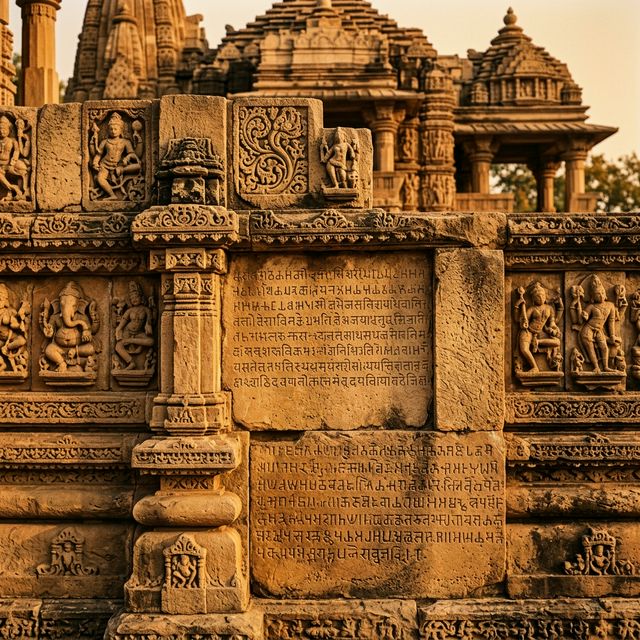
The Kanakhera stone inscription, currently housed in the Sanchi Museum, was discovered in a well at Kanakhera near Sanchi (Madhya Pradesh). Engraved in the Brāhmī script, the six-line Sanskrit record documents the rule of the śaka commander Śrīdharavarman in Central India.
The inscription records the excavation of a perpetual well by mahādaṇḍanāyaka Śrīdharavarman, the righteous śaka conqueror and son of śaka Nanda. Acknowledging devotion to Mahāsena, the divine commander of the celestial army, Śrīdharavarman commissioned this public water source to acquire religious merit, eternal heaven, and general welfare. The well is described as universally accessible, visually pleasing, and containing clear, perennial water. The charter specifies the date of this philanthropic act as the tenth day of the dark fortnight of Śrāvaṇa during his thirteenth victorious regnal year, and the year 102 of the Kalacuri era, corresponding to 351–352 CE.
1. siddham | bhagavatastridaśagaṇasenāpaterajitasenasya svāmimahāsenamahākumārasyadivyavīryyājjitavijaya ………………………
2. dharmmavijayinā śakanandaputreṇa mahādaṇḍanāyakena śakena śrīdharavarmmaṇā varṣa sahasrāya svarājyābhivṛddhikare vaijayike samvatsare trayodaśe
3. śrāvaṇabahulasya daśamyāmetaddivase kalyāṇābhyudayavṛddhyartthamkṣayasvarggāvāpihetorddharmmayaśorttham dharmmāsisambuddhayā śraddhayā
4. śāśvatam candrādityakālikoyam ………………………………| …………… prasannasalilaḥ sarvvādhigamyaḥ sadā
5. sattvānām priyadarśano jalanidhirddharmmābhṛtaḥ śāśvataḥ | ………………….praṇamya manasā dravyasya kṛtvā vyayam
6. kūpaḥ śrīdharavarmmaṇā guṇavatā khānāpitoyam śubhaḥ || 100 2 | sa siddhamastu ||
Lines 1 to 3
Success! This well, lasting forever as long as the sun and the moon endure, has been excavated by the mahādaṇḍanāyaka śaka Śrīdharavarman, the son of the śaka Nanda, the righteous conqueror, who meditates on the feet of the Great Kumāra, the divine Lord Mahāsena (Kārttikeya), the commander of the celestial hosts, whose army has never been vanquished and who, by his celestial prowess, attained victories……………….on this day, namely, the tenth day of the dark fortnight of Śrāvaṇa, in the victorious thirteenth year, augmenting his dominion for a thousand years. He was actuated by religious faith awakened by the sword of righteousness, for the increase of welfare and prosperity, the eternal attainment of heaven, and the acquisition of religious merit and fame.
Lines 4 to 5
This excellent well, containing clear water and matchless in shape, which is always accessible to all, has an appearance pleasing to all living beings, and is a perennial store of water. It has been caused to be excavated for the acquisition of religious merit by the meritorious Śrīdharavarman, having mentally paid obeisance to…………….. and spent a large sum of money.
Line 6
In the year 102 (100 and 2). May there be success!
| Dynasty: | Māhiṣmatī |
| Ruler: | Śrīdharavarman |
| Date: | 351 to 352 C. E. ( Śrāvaṇa, kṛṣṇa 10; 13th regnal year, varṣa 102) |
| Place: | Sanchi Museum, Madhya Pradesh |
| Donor: | Śrīdharavarman |
| Donee: | General public of Kankhera |
| Language: | Sanskrit with Prakrit influence |
| Script: | Brāhmī |
| Religion: | Śaivism |
| Deities: | Mahāsena |
| Nature of grant: | Dedicatory record |
| Purpose: | To increase the religious merits, welfare prosperity, and eternal attainment of heaven, and fame |
| Provenance of inscription: | Kanakhera, Sanchi, Madhya Pradesh |
| Type of Inscription: | Stone Inscription |
| Source: |
Bibliography & Research
- Banerjee, R. D. (1918). Progress Report of the Archaeological Survey of India Western Circle. Archaeological Survey of India.
- Banerjee, R. D. (1921). No 16. The Sanchi Inscription of Svamin Jivadaman: the 13th Regnal Year. Epigraphia Indica, XVI, 230-233.
- Mazumdar, N. G. (1902). Chapter XXII: Inscriptions of Kushanas, Guptas and Later Period. In Monuments of Sanchi (Vol. Vol I, 385-396, here 392). Archaeological Survey of India.
- Majumdar, N. G. (1923). No 28. Sanchi Inscription of Sridharavarman. Journal of the Asiatic Society of Bengal New Series, XIX, 337-342.
- Mazumdar, N. G. (1982). Plate 139: Inscriptions. In J. Marshall & A. Foucher (Eds.), Monuments of Sanchi (Vol. III, Pl. XXXXIX). Archaeological Survey of India.
- Mirashi, V. V. (Ed.). (1955). Corpus Inscriptionum Indicarum Inscriptions of the Kalachuri Chedi Era. In (Vol. Vol 4 (Part 1), xliv-li and 17-19. Archaeological Survey of India.
