
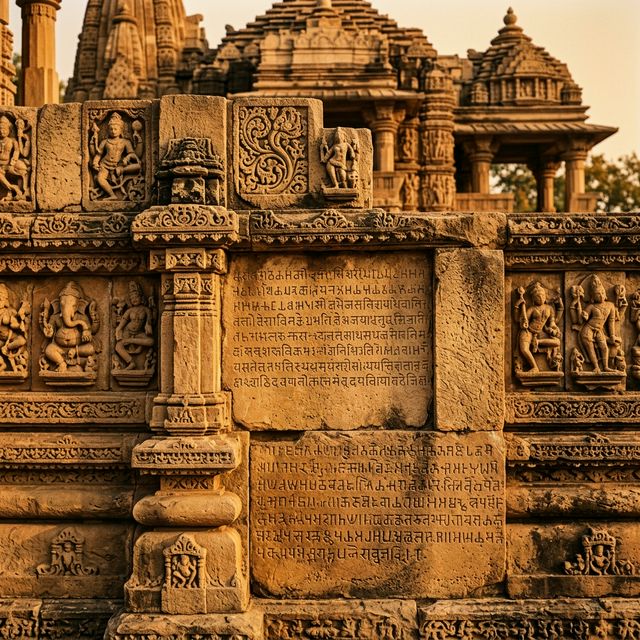
The Barwani copper-plate inscription, discovered in the Barwani district, Madhya Pradesh, is a single-sheet administrative charter issued by mahārāja Subandhu. Incised in Sanskrit language utilising Brāhmī characters, the plate is dated to the seventh day of the bright fortnight of Bhādrapada, year 167 of the Kalacuri era corresponding to 417 CE.
Issued from the city of Mahiṣmati (modern Maheshwar, Madhya Pradesh), mahārāja Subandhu directs an administrative decree to his officers, notably the āyuktakas, within the Udumbaragartā subdivision. The charter formally transfers ownership of a specific field in the village of Sohajanā, previously held by an individual named Sāti. The land is granted as a brahmadeya to the brāhmaṇa Ṣaṣṭhisvāmin of the Bharadvāja gotra, a student of the Vājasaneya śākhā. Granted to increase the religious merit of the ruler and his parents, the decree ensures hereditary cultivation rights for the donee as long as the celestial bodies endure and mandates that local officials cause no obstruction. Guhadāsa served as the dūtaka.1. siddham | svasti | māhiṣmatīnagarāt mahārājasubandhuḥ kuśalī udumbaragarttāpathake
2. sohajanāpaddrake svānāyaktakādīnsamājñāpayati yadatra sātiparibhuktaka-
3. kṣetram tanmayāsmai brahmaṇaṣaṣṭhi svāmine bharadvājasagotrāya vājasa-
4. neya sabrahmacāriṇe mātāpitrorātmanaśca puṇyāpyāyanārtthamācandrārkkārṇṇa va-
5. kālīnam putrapautrānvayabhogyam brahmadeyamatisṛṣṭam | viditvādyadivasādārabhyoci–
6. tayā brahmadeyabhuktyā bhuñjatām na vyāsegha kāryyaḥ | sam 100 607 bhādrapadeśudisapta |
7. guhadāsadūtakaḥ |
(In the margin) śrīsubandhoḥ |
Lines 1 to 4
Success! Hail! From the city of Māhiṣmatī, mahārāja Subandhu, being in good health, issues the following order to his officers, āyuktakas and others, at the village (padraka) of Sohajanā, in the district (pathaka) of Udumbaragartā:
The field, which is at present enjoyed by Sāti here (i.e., at the village Sohajanā), has been granted by me as a brahmadeya gift to this Brāhmaṇa Ṣaṣthisvāmin of the Bhāradvāja gotra, who is a religious student of the Vājasaneya śākhā, to be enjoyed by him as long as the moon, the sun, and the ocean would endure, for the increase of religious merit of my parents and myself.
Line 5
Having known this, you should not cause from this day any obstruction while he is enjoying it according to the condition of enjoying brahmadeya land.
Line 6
In the year 167 (100 and 60 and 7), in the month Bhādrapada and the bright fortnight, on the seventh lunar day. The dūtaka is Guhadāsa.
(In the margin) Of the illustrious Subandhu.
| Dynasty: | Māhiṣmatī |
| Ruler: | Subandhu |
| Date: | 417 CE. (Bhādrapada, śukla 7, varṣa 102) |
| Donor: | Subandhu |
| Donee: | Brāhmaṇa Ṣaṣṭhisvāmin |
| Language: | Sanskrit |
| Script: | Brāhmī |
| Religion: | Vedic |
| Nature of grant: | Land donation |
| Purpose: | To increase the religious merit for the donor and his parents |
| Provenance of inscription: | Barwani, Madhya Pradesh |
| Type of Inscription: | Copperplate grant |
| Source: |
Bibliography & Research
Haldar, R. R. (1924-1925). Annual Report of Rajputana Museum. The Rajputana Museum
- Halder, R. R. (1927). No. 44. The Barwani Copper Plate of Maharaja Subandhu. Epigraphia Indica, XIX, 261-264.
Mirahi, V. V. (1945) The Age of Bāgh Caves. Indian Historical Quarterly, XXI, 79.
- Mirashi, V. V. (Ed.). (1955). Corpus Inscriptionum Indicarum Inscriptions of the Kalachuri Chedi Era. In (Vol. Vol 4 (Part 1), xliv-li and 17-19. Archaeological Survey of India.
