
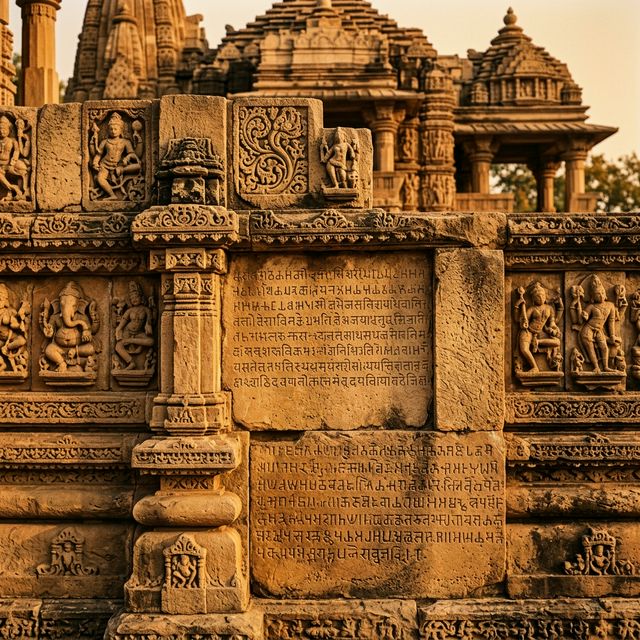
Discovered in Thane and currently housed in the Chhatrapati Shivaji Maharaj Vastu Sangrahalaya (CSMVS), Mumbai, this stone inscription dates to the reign of the Śilāhāra ruler Anantadeva I. It was initially brought to light by Pandit Bhagwanlal Indraji and then published by M. G. Dikshit in the subsequent years. Engraved on a sandstone slab, the record features the sun and moon motifs.
Composed in irregular Sanskrit indicating occasional influence of Marathi, the inscription is written in the Nāgarī script and dates to Śaka 1003 (1081 CE). It serves as a public administrative notice issued during the reign of the mahāmaṇḍaleśvarādhipati Anantadeva I, while the state administration was overseen by the amātya Rudrapaiya. It records the transfer of specific fiscal rights to Ajyapanāyaka, the son of Māvaiya of the Viyāḍika lineage. The grant alienates the total revenue dues of the village Khairāmaṇa, along with the local house-tax assessed in drammas. Furthermore, it transfers the rights to collect specific state levies originally exacted for the entertainment and accommodation of touring royal officials.
1. saṃvat 1003 mahāmaṇḍaleśvarādhipatiśrī-anan-
2. tadevavijayarājye amātyarudrapaiyādiṣu śrīkaraṇacintāṃ vahatsu | viyā-
3. ḍikavaṃśamāvaiyasuta ajyapā nāyakasya khai-
4. rāmaṇe siddhāya deṇā paḍaṇaṃ gṛhadramma dattāḥ |
In the year 1006, while the Amātya Rudrapaiya and others are bearing the burden of the cares of the administration during the victorious reign of the mahāmaṇḍaleśvararādhipati, the illustrious Anantadeva, the revenue dues, the cess for the entertainment and accommodation of royal servants and the house-tax in drammas in the village Khairāmaṇa are donated to Ajyapanāyaka the son of Māvaiya of the Viyāḍika family.
| Dynasty: | Śilāhāra |
| Ruler: | Anantadeva I |
| Date: | 1081 CE (Śaka 1003) |
| Place: | Chhatrapati Shivaji Maharaj Vastu Sanghralaya, Mumbai |
| Donee: | Ajyapanāyaka |
| Language: | Sanskrit influenced by Marathi |
| Nature of grant: | Monetary donation, Administrative order |
| Purpose: | To provide financial support by assignment of village |
| Provenance of inscription: | Vihar, Maharashtra |
| Type of Inscription: | Stone inscription |
| Source: |
Bibliography & Research
- Barnett, L. D. (1916). No. 28 Inscriptions At Narendra. Epigraphia Indica, XIII, 298-326, here p 316 and 323.
- Dikshit, M. G. (1953). Panjim Plates of Jayakeshi (I) Saka 981. Indica: The Indian Historical Research Institute Silver Jubilee Commemoration Volume, 89-94.
- Fleet, J. F. (1867-70). Some further inscriptions relating to Kadamba Kings of Goa. Journal of the Bombay Branch of the Royal Asiatic Society, IX, 262-313.
- Hodivala, S. H. (1920). Studies in Parsi History. Bahauddin College, Junagadh, pp 80-82.
- Hodivala, S. K. (1920). Parsis in Ancient India. The Sanj Vartaman Press.
- Mirashi, V. V. (Ed.). (1977). Corpus Inscriptionum Indicarum, Vol. VI: Inscriptions of the Śilāhāras. Archaeological Survey of India, pp xv-xvi and 113-115.
