
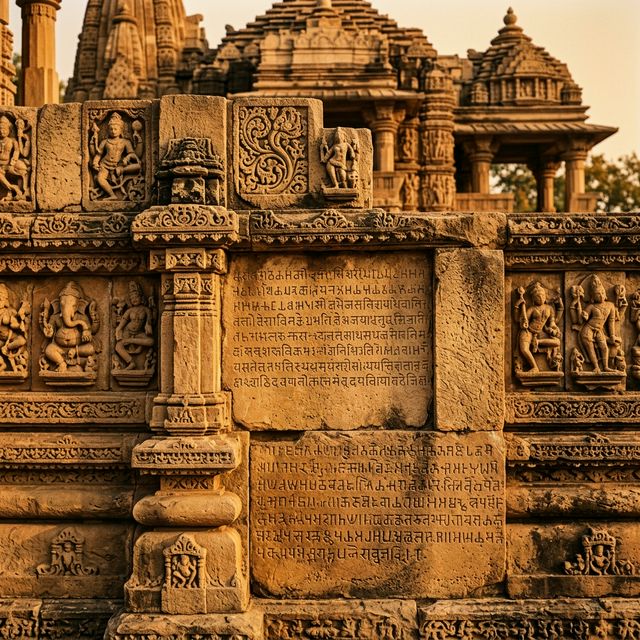
These three copper plates, discovered in 1965 in a tank at Panchapakhadi in Thane, represent the only known epigraphical record of the Śilāhāra king Nāgārjuna till now. They are now kept in the Department of Archaeology and Archives, Government of Maharashtra. Strung with a ring bearing the Garuḍa seal, the plates are inscribed in the Nāgarī script and feature a well-preserved text in Sanskrit prose and verse. The charter was drafted by the treasury officer Jogapaiya.
The inscription records a land grant by the mahāmaṇḍaleśvara Nāgārjuna to Mādhava paṇḍita after having offered arghya to the Sun and having worshipped lord Śiva. The donee was a Yajurvedin scholar belonging to the Pārāśara gotra who emigrated from Hastigrāma, Madhya Pradesh. Dated to Śaka 961 (1039 CE) on a solar eclipse, the grant records a donation of the Muñjavalī village. The donation was intended to support the recipient's fulfillment of six traditional religious duties and the maintenance of his family. The record meticulously delineates the village boundaries using local flora and landmarks, including the Ulhas River, while specifying an annual revenue value of three hundred drammas. The grant concludes with a sequence of benedictory and imprecatory verses.
 Editor's Comment:
First Plate
1. siddham jayaścāśyudayaśca || labhate sarvvakāryeṣu pūjayā gaṇanā yakaḥ | vighnaṃ nighnansa vaḥ
2. pāyādapāyādgaṇanāyakaḥ || sa vaḥ pātu śivo nityaṃ yanmaulau bhāti jāhnavī | sumeruśi-
3. kharodgacchadacchacandrakalopamā || jīmūtaketutanayo niyataṃ dayālurjjīmūtavāhana iti trijaga-
4. tprasiddhaḥ | dehaṃ nijaṃ tṛṇamivākilayanparārtthe yo rakṣate sma garuḍātkhalu śaṅkhacūḍam || tasyānvaye ni-
5. khilabhūpatimaulinūtnaratnadyuticchuritanirmmalapādapīṭhaḥ | śrīsāhasāṅka iva sāhasikaḥ kaparddī sī-
6. lāravaṃśa tilako nṛpatirbba bhūva || tasmādabhūcca tanayaḥ pulaśaktināmā sīmāsamaḥ suragurūditarā-
7. janīteḥ | nirjjitya saṅgaramukhekhilavairivarggaṃ niṣkaṇṭakaṃ jagati rājyamakāri yena || tato
8. pi samabhūtsuto nṛpaśirovibhūṣāmaṇiḥ śitaḥ sṛṇirivāparorikariṇāṃ kaparddī laghuḥ | ya-
9. dīyayaśasā jagatyatiśayena śuklīkṛte na bhāti suravāraṇo na ca śaśī na dugdhāmbudhiḥ || tasmā-
10. dapyabhavadvibhūtipadavīpātraṃ pavitrīkṛtāśeṣakṣmāvalayo mahīpatilakaḥ śrīvappuvannaḥ
11. sutaḥ | saṅgrāmāṅgaṇaraṅgiṇāsilatayā lūnaikadantā haṭhātsarvve yena vināyakā viracitā
12. vidveṣiṇāṃ dantinaḥ || tasmājjātastanūjo rajanikara ivānanditāśeṣalokaḥ ślāghyaḥ śrījhañ-
13. jharājo divasakara iva dhvastaniḥ śeṣadoṣaḥ | śaṃbhoryo dvādaśāpi vyaracayadacirātkīrttanāni
14. svanāmnā sopānānīva manye praṇatatanubhṛtāṃ svarggamārgodyatānām || bhrātā tatra tatastatojjvalaya-
15. śorāśīprakāśīkṛtāśeṣakṣmāvalayo | balī balavatāṃ śrīgoggirājobhavat | cāpākarṣaṇaka-
16. rmmaṇi pravaṇatāṃ yasmingate bhūpatau bhīṣmadroṇapṛthāsutaprabhṛtayaścitte camatkāritāḥ || tasmādvi-
17. smayakārihāricaritaprakhyātakīrttiḥ sutaḥ śrīmānvajjaḍadevabhūpatirabhūdbhacakracūḍāmaṇiḥ | do-
18. rddaṇḍaikabalasya yasya sahasā saṅgrāmaraṅgāṅgaṇe rājyaśrīḥ svayameva vakṣasi rati cakre murāreriva ||
19. jayanta iva vṛtrāreḥ purāreriva ṣaṇmukhaḥ | tataḥ śrīmānabhūtputraḥ saccaritroparājitaḥ ||
20. karṇṇastyāgena yaḥ sākṣātsatyena ca yudhiṣṭhiraḥ | pratāpāddīptimārttaṇḍaḥ kāladaṇḍaśca yo dvi-
21. ṣām || śaraṇāgatasāmantā aparepi ca jagati rakṣitā yena | sa jayati yathārtthanāmā
22. śaraṇāgatavajrapañjaro devaḥ || yena svāgatamāgatāya vihitaṃ gommāya nānāvidhaṃ yenai-
Second Plate : First Side
23. vaiyapadevanāmni calitaṃ rājyaṃ sthiraṃ kāritam | bhillammāmmamambuvakṣitibhujāṃ dattaṃ ca yenā-
24. bhayaṃ tasya śrībidaṅkarāmanṛpateranyatkimāvarṇṇyate || tasmādbabhūva bhuvi vajjaḍadeva-
25. nāmā bhūpālamastakamaṇistanayo nayajñaḥ | adyāpi yasya caritāni janāḥ sama-
26. mtā romāñcakañcukitagātralatā stuvanti || tadbhrātātha tatorikesarinṛpo jātaḥ sa-
27. tāṃ sammato dṛptārātikulācalaikadalane daṃbholilīlāṃ dadhāt | gatvā śaiśa va eva sainyasahi-
28. to dṛṣṭvā ca someśvaraṃ tasyāgre puturājñayā jagadalaṃ yaḥ kīlayitvāgataḥ || tadbhrātṛjo vajjaḍadeva-
29. sūnuḥ śrīcchittarājo nṛpatirbbabhūva | sīlāravaṃśaḥ śiśunāpi yena nītaḥ parāmunnatimunnatena ||
30. hatārinārīnetrāṃbhassekasaṃvarddhanādiva | brahmāṇḍamaṇḍapaṃ yasya kīrttivallyatirohati || dṛptārāti-
31. ṣu kopakāladahanaḥ saubhāgyanārāyaṇo vārastrīṣu tatonujaḥ samabhavannāgārjunaḥ kṣmā-
32. patiḥ | yasyāmānuṣamūrjjitaṃ bhujabalaṃ dūrānniśamya dviṣāṃ nidrātīva raṇāṅgaṇavyasaninī
33. dorddaṇḍakaṇḍulatā || yadasamaśivirāntarmmattagandhebhadāna- prasaradanilaśuṣyatsrotaso
34. diggajendrāḥ| arinagaravidāhoddāmadigvyāpidhūma- prasarabhayanimīlallocanānyunmiṣa-
35. nti || atha svakīyapuṇyodayātsamadhigatapañcamahāśabda- mahāsāmantādhipatitagarapuraparameśva-
36. raśrīsīlāranaredrajīmūtavāhanānvayaprasūtasuvarṇṇagaruḍadhvaja- sahajavidyādharakodaṇḍasaha-
37. srārjunanarendranāgārjunatyāgajagajjhampaśaraṇāgata- vajrapañjaraprabhṛtisamastarājāvalīvi-
38. rājitamahāmaṇḍaleśvaraśrīmannāgārjunarājadeve nijabhujopārjjitānekamaṇḍalasame-
39. tāṃ purīpramukhacaturddaśagrāmaśatīsasamanvita- samastakoṅkaṇabhuvaṃ samanuśāsati tathaitadrājyacintā-
40. bhāramudvahati mahāmātyaśrīdaddhapaiye tathā mahāsāndhivigrahikaśrīsoḍhalaiye satyetasminkā-
41. le pravarttamāne sa ca mahāmaṇḍaleśvaraśrīmannāgārjunarājadevaḥ sarvvāneva svasambadhyamānakānanyā-
42. napi samāgāmirājaputramantripurohitāmātyapradhānāpradhānanai yogikāṃstathā rāṣṭrapativiṣayapa-
43. tinagarapatigrāmapatiniyuktāniyuktarājapuruṣajanapadāṃstathā haṃyamananagarapauratrivarggapra-
44. bhṛtīṃśca praṇatipūjāsatkārasamādeśaiḥ sandiśatyastu vaḥ saṃviditaṃ yathā || calā vibhūtiḥ kṣaṇaḥ
Second Plate : Second Side
45. bhaṅgi yauvanaṃ kṛtāntadantāntaravartti jīvitam | tathāpyavajñā paralokasādhane nṛṇāmaho visma-
46. yakāri ceṣṭitam || tathā cāntarllīnajarārākṣasīprārabdhagrāsaṃ yauvanaṃ svarggavāsānnarakapātasa-
47. mamiṣṭasamāgamaviyogaduḥkhaṃ kadalīgarbbha vadasāgaraḥ saṃsāraḥ | sahajajarāmaraṇasādhāra-
48. ṇakaṃ śarīraṃ pavanacalitakamalinīdalagatajalalavataralatare dhanāyuṣī iti matvā dṛḍhata-
49. raviraktibuddhyā saṅgṛrhṇāyāt dānaphalam || kṛtatretādvāpareṣu tapotyartthaṃ praśasyate | munayotra
50. tu śaṃsanti dānamekaṃ kalau yuge || tathā coktaṃ bhagavatā vyāsena | agnerapatyaṃ prathamaṃ suvarṇṇaṃ bhūrvveṣṇa-
51. vī sūryasutāśca gāvaḥ | lokatrayantena bhaveddhi dattaṃ yaḥ kāñcanaṃ gāṃ ca mahīñca dadyāt || āspho-
52. ṭayanti pitaraḥ pravalganti pitāmahāḥ | bhūmidosmatkule jātaḥ sa naḥ santārayiṣyati || bhūmi-
53. dānaṃ supātreṣu sutīrttheṣu suparvvasu | agādhāpārasaṃsārasāgarottāraṇaṃ bhavet || dhavalānyā-
54. tapatrāṇi dantinaśca madoddhatāḥ | bhūmidānasya puṣpāṇi phalaṃ svargge purandaraḥ || iti dharmmādharmmavi-
55. cāracaturacirantanamunivacanānyavadhārya mātāpitrorātmanaśca śreyortthinā mayā śakanṛpakālātīta-
56. saṃvatsaraśateṣu navasu ekaṣaṣṭyadhikeṣu pramāthināma- saṃvatsarāntarggataśrāvaṇavadi pañcadaśyāṃ yatrāṅkatopi saṃva-
57. t 961 śrāvaṇa vadi 15 budhe sañjātasūryagrahaṇaparvvaṇi sutīrtthe snātvā gaganaikacakracūḍāmaṇaye kama-
58. linīkāmukāya bhagavate savitre nānāvidhakusumaślāghyamarghyaṃ dattvā sakalasurāsuraguruṃ trailokyasvāmi-
59. naṃ bhagavantamumāpatimabhyarccya yajanayājanādhyayanādhyāpanādiṣaṭkarmaniratāya kratukriyākāṇḍaśauṇḍā-
60. ya paramabrahmaṇe mahābrāhmaṇāya hastigrāmanirggatāya madhyadeśāntaḥpātihastigrāmavinirggatāya pārāśaragotrāya yajurvvedaśā-
61. khine mādhavapaṇḍitāya gokarṇṇapaṇḍitasutāya yajanayājanādhyayanādhyāpanādiṣaṭkarmmakaraṇāya bali-
62. caruvaiśvadevāgnihotrakratukriyādyupasarppaṇārttha svaparigrahapoṣaṇārtthaṃ ca koriyaladvādaśakānta-
63. pāti muñjavalīgrāmaḥ | yasya cāghāṭanāni pūrvvataḥ doṇāgrāmasīmāsandhau madhūkavṛkṣaḥ tathā rāja-
64. mārggaḥ tathā voḍaṇaṃ tathā udumbaravṛkṣaḥ tathā jhotiśca || dakṣiṇataḥ vā-igaṅgaṇīgrāmasīmāsaṃ-
65. dhau vaṃve pipparī tathā badarī varalī ca || paścimato dhavalāgrāmasīmāsandhau udumbaravṛkṣaḥ tathā
66. madhūkavṛkṣaśca || uttarataḥ kuḍisavarāgrāmasīmāsandhau nadī tathā khaḍakavira-ikā ca || evaṃ caturā-
Third Plate
67. ghāṭanopalakṣitaḥ svasīmāparyantaḥ savṛkṣamālākulaḥ satṛṇakāṣṭhodakopetaḥ parvvatakṣiti-
68. samakālīnaḥ pūrvvadattadevadāyabrahmadāyavarjja pūrvvaprasiddhyā bhaṭṭhaukāsādisahi-
69. taḥ acāṭabhaṭaprāveśyaḥ anādeśyaḥ anāsedhyaḥ samutpadyamānadrammaśatatrayasaṅkhyaḥ
70. udakātisarggeṇa namasyavṛttyā paramayā bhaktyā pratipāditaḥ | tadasya sānvayabandho-
71. rapi bhuñjato bhojayato vā kṛṣataḥ karṣayato vā na kenāpi paripanthanā karaṇīyā || ya-
72. ta uktameva purātanamahāmunibhirbba hubhirvvasudhā bhuktā rājabhiḥ sagarādibhiḥ | yasya yasya
73. yadā bhūmistasya tasya tadā phalam || sadyodānaṃ nirāyāsaṃ sāyāsaṃ dīrghapālanam ata eva-
74. rṣayaḥ prāhurddānācchreyonupālanam || dattvā bhūmiṃ bhāvinaḥ pārtthivendrānbhūyo bhūyo yācate
75. rāmabhadraḥ | sāmānyoyaṃ dharmmaseturnnṛpāṇāṃ kāle kāle pālanīyo bhavadbhiḥ || iti muniva-
76. canānyavadhārya samāgāmibhūpālairasmadvaṃśajairanyairvvā pālana- dharmmaphalalobha eva kara-
77. ṇīyaḥ | na punastallopanapāpakalaṅkāgresareṇa kenāpi bhavitavyam | yastvevamabhyartthito-
78. pi lobhādajñānatimirapaṭalāvṛtamatirācchiṃdyādācchidyamānamanumodeta vā sa pañcabhi-
79. rmmahāpātakairupapātakaiśca liptau rauravamahārauravāndhatāmisrā dinarakāṃściramanubha-
80. viṣyati || tathā coktaṃ bhagavatā vyāsena || svadattāṃ paradattāṃ vā yo hareta vasundharām |
81. sa viṣṭhāyāṃ kṛmirbhūtvā kṛmibhiḥ saha pacyate || vindhyāṭavīpvatoyāsu śuṣkakoṭaravāsi-
82. naḥ | mahāhayo hi jāyante bhūmidāyaṃ haranti ye || gāmekāṃ svarṇṇamekaṃ vā bhūmerapyekamaṃ-
83. gulam | harannarakamāpnoti yāvadābhūtasaṃplavam || ṣaṣṭiṃ varṣasahasrāṇi svargge tiṣṭhati bhūmi-
84. daḥ | ācchettā cānumantā ca tānyeva narake vaset || yathā caitadevaṃ tathā śāsanadātā le-
85. khakahastena svamatamāropayati | yathā mataṃ mama mahāmaṇḍaleśvaraśrīmannāgārjunarājade-
86. vasya mahāmaṇḍaleśvaraśrīmadvajjaḍadevarājasūyoryadatra śāsane likhitam | likhitaṃ caitanma-
87. yā śrīmadrājānujñayā bhāṇḍāgārasenaśrījogapaiyena bhāṇḍāgārasenamahākaviśrīnāgalai-
88. yabhrātṛsūnunā | yadatronākṣaramadhikākṣaraṃ vā tatsarvaṃ pramāṇamiti || maṅgalamiti || śrīḥ ||
Verse 1
May that Gaṇanāyaka (i.e. Gaṇapati) protect you from calamity—he who destroys obstacles and who, by means of worship, receives attention in all undertakings!
Verse 2
May that Śiva always protect you—he on whose head the Gaṅgā shines like the bright crescent of the moon as it rises over the peak of Sumeru!
Verse 3
Jīmūtavāhana, the ever compassionate son of Jīmūtaketu, is well-known in the three worlds—who, valuing his own body as not better than a straw, saved, indeed, Śaṇkhacūḍa from Garuḍa.
Verse 4
In his family was born king Kapardin I, the ornament of the Śīlāra race, who was adventurous like the illustrious Sāhasāṅka (i.e.Vikramāditya) and whose stainless foot-stool was covered with the splendour of fresh jewels on the heads of all kings.
Verse 5
From him sprang his son, Pulaśakti by name, who represented the limit of political wisdom taught by Bṛhaspati, the preceptor of gods; who, having vanquished all enemies in the forefront of the battlefield, ruled over the world, free from trouble.
Verse 6
From him again sprang his son, the younger Kaparadin (i.e., Kapardin II), the crest-jewel of kings, who was as it were a sharp goad to the elephants in the form of his enemies; the world being exceedingly whitened by his fame, neither the heavenly elephant (Airāvata) nor the moon nor the milk-ocean could be distinguished.
Verse 7
From him again sprang his son, the illustrious Vappuvanna, the worthy abode of prosperity, an ornament of royalty, who sanctified the whole circle of the earth. Having one of their tusks forcibly cut off by the creeper-like sword of him who was delighted to fight on the field of battle, all the elephants of the enemies were turned into Vināyakas i.e. they become Gajānana, who has only one tusk.
Verse 8
From him sprang his praiseworthy son, the illustrious Jhañjha, who delighted all people even as the moon does, and who destroyed all blemishes even as the sun dispels all darkness; who erected twelve temples of Śiva, named after himself, which served, as it were, as steps to pious people, ready to repair to the path of heaven.
Verse 9
Then there rose his brother, the illustrious Goggirāja, who having a mass of brilliant fame, brightened the entire circle of the earth, and who mighty among the mighty; when that king bent down in the act of drawing the string of his bow, Bhīṣma, Droṇa, the son of Pṛthā (i.e. Arjuna) and others felt surprised in their minds.
Verse 10
From him sprang a son named the illustrious Vajjaḍadeva I, famed for his astounding and attractive deeds, the crest-jewel of the circle of the earth. Royal Fortune, approaching him, all of a sudden and of her own accord, on the battle-field, felt delighted while sporting on the bosom of him whose strength lay solely in his own arm, as it does on that of Murāri.
Verse 11
To him was born an illustrious and virtuous son named Aparājita as Jayanta was to Indra and as the six-faced Kārttikeya was to Śiva.
Verse 12
He was Karṇa himself in respect of liberality, Yudhiṣṭhira in that of truthfulness, the refulgent Sun in that of valour, and was the rod of the god of death to his enemies.
Verse 13
Victorious is that king, who protected even the feudatories of other kings when they sought refuge with him, and who rightly obtained the title of "the adamantine cage giving protection to those who seek it.”
Verse 14
What else can be described of him who welcomed in various ways Gomma, who resorted to him for protection, who caused to be made firm the infirm rule of Aiyapadeva, who gave protection to Bhillama, Ammaṇa and Mambuva, and who was thus veritable Rāma among title-holders.
Verse 15
From him was born the son named Vajjaḍadeva II, who was conversant with political wisdom and was a veritable crest-jewel of kings,—whose deeds all people even now praise, with their creeper-like bodies having clothes of horripilation.
Verse 16
Then there was born his brother, king Arikesarin, who had the grace of the thunderbolt in destroying the principal mountains in the form of arrogant foes; who, even when he was a boy, went with an army to Someśvara and having seen that god, came back after offering him the whole world by the order of his father.
Verse 17
Thereafter his brother’s son the illustrious Chittarāja became king, who, noble as he was, raised his Śīlāra family to great eminence, though he was then only in his boyhood.
Verse 18
The creeper of his fame rises up to the maṇḍapa of the Brāhmāṇḍa, being as it were fostered by the tears from the eyes of the wives of the enemies killed by him.
Verse 19
Then his younger brother Nāgārjuna became king—he whose wrath was the fire of destruction to his arrogant foes, and who was Nārāyaṇa in respect of good nature while dealing with courtesans. Having heard from afar about his superhuman and great might of arms, the itching of his enemies, fond of the field of battle, goes to sleep as it were.
Verse 20
The quarter-elephants, the streams of whose ichor dry up on the spread of the breezes blowing over the rut of the intoxicated scent-elephants in his unique camp, open their eyes after a long time—the eyes which had been closed through fear when the enormous smoke springing from the conflagration of his enemies’ cities spread in the quarters.
Line 35-53
Now, while the mahāmaṇḍaleśvara, the illustrious king Nāgārjuna—who, by his spiritual merit, has obtained the five mahāśabdas, and who is adorned with all royal titles such as mahāsāmantādhipati, ‘the lord of the city of Tagara,’ ‘an illustrious king of the Śīlāra family’, ‘a scion of the family of Jīmūtavāhana,’ ‘he who has the ensigh of the golden Garuḍa’, ‘he who is a born Vidyādhara’, ‘he who is the veritable king Sahasrārjuna by his bow’, ‘he who is veritable Nāgārjuna among kings (poison-curers)’, ‘he who is world-renowned in liberality’ and ‘who is an admantine cage for the protection of those who seek refuge with him’—is ruling over the entire Koṅkaṇa country comprising fourteen hundred villages headed by Purī, together with many other maṇḍalas acquired by the power of his arm, and while the mahāmātya, the illustrious Daddhapaiya and the mahāsāndhivigrahika, the illustrious Soḍhalaiya are bearing the burden of the cares of his government,—the mahāmaṇḍaleśvara, the illustrious Nāgārjunadeva addresses, with salutation, honour and respect, all assembled princes, counsellers, the family priest, the amātyas, the principal and subordinate officers as well as the heads of rāṣṭras, viṣayas, towns and villages, royal servants, whether formally appointed or not, and the village-people, as also the artisans, guilds and the three classes of citizens and so forth as follows:-
“Be it known to you that realising that prosperity is unsteady, youth is momentary and life lies in the jaws of death, that the body is subject to old age and death natural is this world, and that life is fickle like drops of water on a lotus leaf tossed by wind, they confirm the religious rewards of gifts. Having considered the sayings of ancient sages which are delightful owing to their distinguishing between what is righteous and what is not, such as the following of holy Vyāsa—‘Gold was the first-born of Fire, land sprang from Viṣṇu, and the cows are the off-springs of the Sun. He who gives gold, land and a cow gains the religious merit of giving the three worlds.’
Line 54-69
Having thought over these sayings of old sages adept in discriminating between dharma and adharma and having bathed at an excellent tīrtha on the holy occasion of a solar eclipse which occurred on Wednesday, the fifteenth tithi of the dark fortnight of Śrāvaṇa in the cyclic year Pramāthin, when nine hundred years increased by sixty-one had expired by the era of the Śaka king—in figures, the year 961, the month Śrāvaṇa, the dark fortnight and the tithi 15—and having offered an arghya, beautiful with flowers of various kinds, to the divine Sun, the sole crest-jewel of the sky and the lover of the lutusplant, and having worshipped the divine Śiva, the lord of the three worlds and the guru of all gods and demons, —I have given, for the spiritual welfare of my mother and father and of myself, as a gift free from all taxes with great devotion and with the pouring out of water to the great Brāhmaṇa Mādhava Paṇḍita, son of Gokarṇa Paṇḍita, of the Pārāśara gotra and the Yajurveda śākhā, who has emigrated from Hasti-grāma situated in the Madhyadeśa, for the performance of the six religious duties such as sacrificing for himself and for others, and studying and teaching of the sacred texts, for the performance of such rites as bali, caru, vaiśvadeva, agnihotra and so forth, and for the maintenance of this family, the village Muñjavalī included in the territorial division Koriyala-12—the boundaries of which are as follows:- on the east the junction with the boundary of the village Doṇā, a Madhūka tree, a highway and voḍaṇa, and also an Udumbara tree and a jhoti; on the south, near the junction of the village Vaiṇgaṇī the trees Vanive, Pipparī, Badarī, and Varalī; on the west, near the junction of the village Dhavalā, an Udumbara tree and a Madhūka tree; on the north, near the junction of the boundary of the village Kuḍisavarā, the river and a khaḍaka-viraikā—the village, with its boundaries thus determined, extending to its limits, together with clusters of trees, together with grass, wood and water, to be enjoyed as long as the mountains and the earth would endure, exclusive of gifts previously made to gods and Brāhmaṇas and together with low and fallow lands in accordance with the previous custom, which is not to be entered by cāṭas and bhaṭas, not to be assigned and not to be attached, and which carries with it three hundred drammas being the cost of the crop produced therein.
Line 70
Therefore, none should cause any obstruction while he together with his relatives is enjoying or allowing others to enjoy it, while he is cultivating it himself or is allowing others to cultivate it.
For it has already been said by ancient sages:-
(Here follow seven benedictory and imprecatory verses.)
Line 84-88
And as it is, the giver of the charter records his approval by the hand of the scribe: “What is written in this charter has been approved by Me, the mahāmaṇḍaleśvara, the illustrious Nāgārjunadeva, the son of the mahāmaṇḍaleśvara, the illustrious Vajjaḍadevarāja.”
And this has been written by me, the treasury officer, the illustrious Jogapaiya, the nephew of the treasury officer, the illustrious Mahākavi Nāgalaiya.
Whatever is written here in deficient or redundant letters—all that is authoritative.
May there be happiness! May there be prosperity!
| Dynasty: | Śilāhāra |
| Ruler: | Nāgārjuna |
| Date: | 27th August 1039 CE (Śrāvaṇa kṛṣṇa 15, Śaka 961) |
| Place: | Department of Archaeology and Archives, Government of Maharashtra |
| Donee: | Mādhava Paṇḍita |
| Language: | Sanskrit |
| Nature of grant: | Land donation |
| Purpose: | For the performance of the six religious duties by the donee Brāhmaṇa |
| Provenance of inscription: | Panch pakhadi, Thane, Maharashtra |
| Type of Inscription: | Copperplate grant |
| Source: |
Bibliography & Research
- Dikshit, M. G. (1968). Thana plates of Silahara Nagarjuna: Śaka 961. Epigraphia Indica, XXXVII, 247–257. Archaeological Survey of India.
- Ganguly, D. C. (2001) Chapter VI: Later Cālukyas and Kalachuris of Kalyaṇa. In Ramkrishnan, S. (Ed.) History and Culture of the Indian People: The Struggle for Empire (5th ed., Vol. V, p. 171). Bharatiya Vidya Bhavan.
- Mirashi, V. V. (Ed.). (1977). Corpus Inscriptionum Indicarum, Vol. VI: Inscriptions of the Śilāhāras. Archaeological Survey of India, pp xii&xiv and 75-82&132.
- Ritti, S., & Shelke, G. C. (1968). Inscriptions of the Cālukyas of Kalyaṇa: Someśvara I. In Inscriptions from the Nanded District (pp. 5-11). Sharda Bhuvan Education Society.
- Soddhala. (1920). Udayāsundarikathā (E. Krishnamacharya, Ed.). The Gujarati Printing Press, p. 152.
