
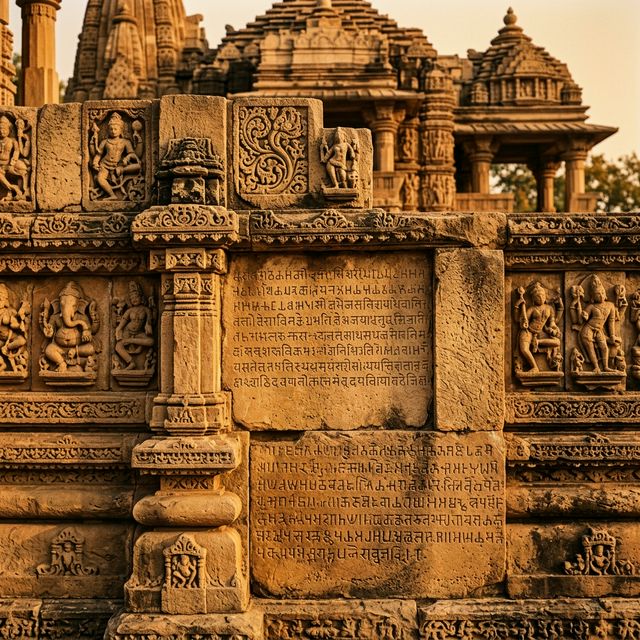
Discovered in 1958 at Mahul near Trombay, this yellowish-white sandstone slab dates to the Śaka 1075 (1153 CE) during the reign of the Śilāhāra ruler Haripāladeva. The neatly engraved stele features a maṅgala kalaśa flanked by the sun and moon at the top, ten lines of text in the middle, and the traditional imprecatory ass-curse panel at the bottom. The record is engraved in the Nāgarī script, while the language, being mainly Sanskrit, shows influences of Marathi.
The inscription functions as a public administrative notification, recording specific fiscal policies for the village of Māhavala (modern Mahul) within the Ṣaṭṣaṣṭi district (viṣaya). Promulgated through the ritual pouring of water by Haripāladeva, it explicitly grants brāhmaṇas an exemption from the local house-tax and fixes the agricultural tax on areca-nut orchards at a precise rate of three drammas per hundred trees. Additionally, the charter registers a separate, tax-free donation of an orchard in the village of Ḍombila (modern Dombivali, Thane, Maharashtra) to a venerable brāhmaṇa Govardhanabhaṭṭa.
1. siddham || svasti | jayaścābhyudayaśca | śakanṛpakālātītasaṃvatsaraśateṣu da-
2. śasu pañcasaptatyadhikeṣu yatrāṅkatopi saṃvat 1075 śrīmukha-
3. saṃvatsarāntarggata āṣāḍhaśuddha 15 ravidine somaparvaṇi nijaśre-
4. yorthinā mayā śrīharipāladevena ṣaṭṣaṣṭiviṣayāntarggatamā-
5. habalagrāmīyagṛhadeṇanirmuktiḥ tathā vāṭikānāṃ
6. trikaśataṃ grāhyaniti deyavyavasthayā udakātisarggeṇa śāsanena prati-
7. pāditaṃ || māhavalagrāme brāhmaṇāṃ gṛhadeṇe na gehāveṃ | vāṭikā-
8. yāṃ pophalīṃ śataṃ prati drama 3 gehāṃveṃ | tathā ca śrīgovarddhana bha-
9. ṭṭopādhyāyāya ḍoṃbilavāṭikā sarvanamasyam || iti śāsanvya-
10. vasthā jo cālī tehāciye māyā gāḍha-u valagheṃ ||
Success! Hail! May there be victory and prosperity!
In the year ten hundred increased by seventy-five, in figures also, the year 1075, on the occasion of a lunar eclipse on Sunday, the 15th tithi of the bright fortnight of Āṣāḍha in the cyclic year Śrīmukha, 1, the illustrious Haripāladeva, have, for my own spiritual welfare. laid down the following regulation (vyavasthā) by an order by pouring out water—
There shall be exemption from house-tax in the village Mahāvala situated in the viṣaya of Ṣaṭṣaṣṭi, and there shall be a levy of three drammas per hundred on the areca-nut trees.
In the village of Māhavala no house-tax shall be charged to the Brāhmaṇas. Three drammas shall be levied as tax per hundred trees of areca-nuts, in the orchards of the village.
Moreover, the orchard in Ḍombila is granted as a gift free from taxes to the venerable Govardhanabhaṭṭa.
(Here follows the usual ass-curse.)
| Dynasty: | Śilāhāra |
| Ruler: | Haripāladeva |
| Date: | 7th July 1153 CE (Āṣāḍha śuddha 15, Śaka 1075) |
| Place: | Mahāvala village in Ṣaṭṣaṣṭi-viṣaya (modern Māhul, near Mumbai) |
| Donee: | Govardhanabhaṭṭa |
| Language: | Sanskrit mixed with Marathi |
| Nature of grant: | Administrative order |
| Purpose: | For spiritual welfare of the donor and to sustain learned Brāhmaṇas |
| Provenance of inscription: | Mahul, near Mumbai |
| Type of Inscription: | Stone Inscription |
| Source: |
Bibliography & Research
- Altekar, A. S. (1936). The Śilāhāras of Western India. In: Bhandakar (Ed.). Indian Culture, 2, pp 393-434, here pp 415.
- Dikshit, M. G. (1970). Mahul (Trombay) inscription of Haripāladeva. Epigraphia Indica, 37, 165–167.
- Mirashi, V. V. (Ed.). (1977). Corpus Inscriptionum Indicarum, Vol. VI: Inscriptions of the Śilāhāras. Archaeological Survey of India, pp xvii-xviii and 146-148, 279-280.
