
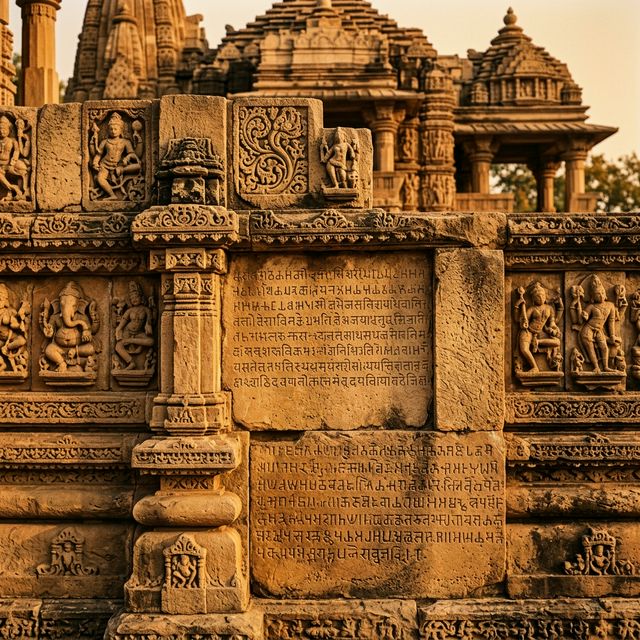
Discovered in the courtyard of a private residence in Agashi, Thane district, Maharashtra, this stone is severely abraded due to its use as a washing stone. The inscription was composed in Sanskrit and engraved in Nāgarī script. Documented by Dr. V. B. Kolte, this record serves as the latest known record of King Aparāditya I. It can be dated to Saturday, 27th November, 1148 CE, the cyclic year being Vibhava. The charter opens with an invocation to Vināyaka and highlights the sovereign authority of the mahāmaṇḍaleśvarādhipati Aparaditya I. Due to weathering and erosion, the specific object of the grant is lost.
1. oṃ namo vināyakāya | svasti | jayaścābhyudayaśca | śakanṛpakālātītasaṃvatsara-
2. śateṣu daśasu saptatyadhikeṣu yatrāṅkatopi saṃvat 1070 vibhavasaṃva-
3. tsarāntarggatamārggaśīrṣaśuddhapañcadaśyāṃ śanau samadhigatāśeṣapañcamahāśabdādi-
4. sakalarājāvalīsamalaṅkṛtamahāmaṇḍaleśvarādhipati śrīmadaparāditya-
5. devakalyāṇavijayarājye nijabhujopārjitānekamaṇḍalasametapurī pramukhasamastakoṅkaṇaṃ
6. samanuśāsati tathaitatprasādāvāptasamastarājyacitābhāraṃ samudvahati ……
Om! Obeisance to Vināyaka! Hail! May there be victory and prosperity!
When ten hundred years increased by seventy—in figures, the years 1070—have lapsed by the era of the Śaka king, on Saturday, the fifteenth tithi of the bright fortnight of Mārgaśīrṣa in the cyclic year Vibhava, in the beneficial and victorious reign of the mahāmaṇḍaleśvarādhipati, the illustrious Aparāditya I, who is adorned with all royal titles such as ‘he who has obtained the five mahāśabdas’—while the King is governing the entire Koṅkaṇa country headed by Purī together with all maṇḍalas conquered by his own army, and while …….. is shouldering all cares of administering the whole kingdom entrusted to him by his favour …………
| Dynasty: | Śilāhāra |
| Ruler: | Aparāditya I |
| Date: | 27th November 1148 CE (Śaka 1070) |
| Place: | Agashi, Thane |
| Language: | Sanskrit |
| Provenance of inscription: | Agashi, Thane |
| Type of Inscription: | Stone inscription |
| Source: |
Bibliography & Research
- Altekar, A. S. (1936). The Śilāhāras of Western India. In: Bhandakar (Ed.). Indian Culture, 2, pp 393-434, here pp 411-415.
- Barnett, L. D. (1916). No. 28 Inscriptions At Narendra. Epigraphia Indica, XIII, 298-326, here p 316 and 323.
- Dikshit, M. G. (1953). Panjim Plates of Jayakeshi (I) Saka 981. Indica: The Indian Historical Research Institute Silver Jubilee Commemoration Volume, 89-94.
- Fleet, J. F. (1867-70). Some further inscriptions relating to Kadamba Kings of Goa. Journal of the Bombay Branch of the Royal Asiatic Society, IX, 262-313.
- Kalhana. (1892). The Rajataranjini (Durgaprasad, Ed.; Vol. Vol I). Government Central Book Deposit.
- Mirashi, V. V. (Ed.). (1977). Corpus Inscriptionum Indicarum, Vol. VI: Inscriptions of the Śilāhāras. Archaeological Survey of India, pp xvii-xviii and 133-142, and 270, line 7, 279-280.
