
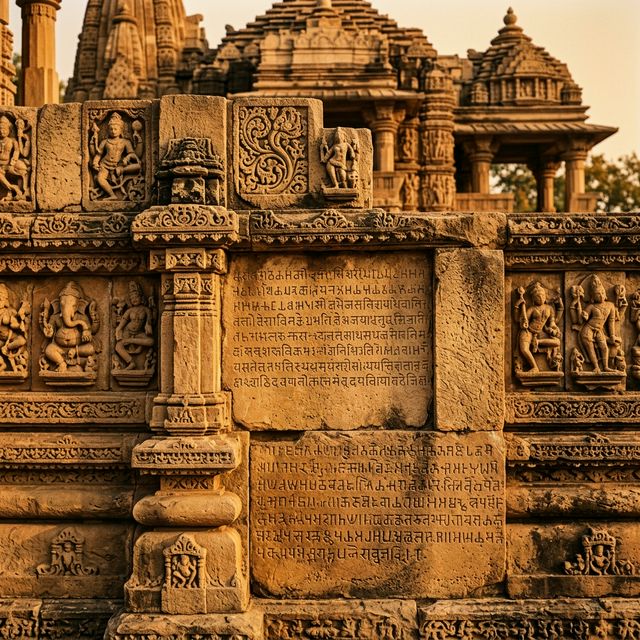
The Ganj stone inscription, discovered in 1919, is an epigraphic record of the subordinate ruler Vyāghradeva. The text is engraved on a detached stone slab found near the Maluha-tongri hill in the Ajayagadh region of Madhya Pradesh. Executed in the box-headed variety of the Brāhmī script, the text is composed in Sanskrit prose. The well-preserved record centers around a wheel motif and belongs to the reign of the Vākāṭaka king Pṛthivīṣeṇa II.
The brief text documents a pious dedication executed by Vyāghradeva for the religious benefit of his mother and father. He explicitly acknowledges his political subservience by declaring that he meditates on the feet of the Vākāṭaka mahārāja Pṛthivīṣeṇa. The exact nature of the dedication is not explicitly specified within the text, but its physical proximity to a ruined stone structure across a local stream suggests it records the construction of a dam.
Vyāghradeva, who meditates on the feet of the illustrious Pṛthiviseṇa II, the Mahārāja of the Vākāṭakas, has made this for the religious merit on his mother and father.
| Dynasty: | Ucchakalpa |
| Ruler: | Vyāghradeva |
| Date: | c. 470 to 490 CE |
| Donor: | Vyāghradeva |
| Language: | Sanskrit |
| Script: | Box-headed Brāhmī |
| Nature of grant: | Religious endowment |
| Purpose: | To record a construction done by the king for the religious merit of his parents |
| Provenance of inscription: | Maluhatongi hill near Ganj, Madhya Pradesh |
| Type of Inscription: | Stone inscription |
| Source: |
